
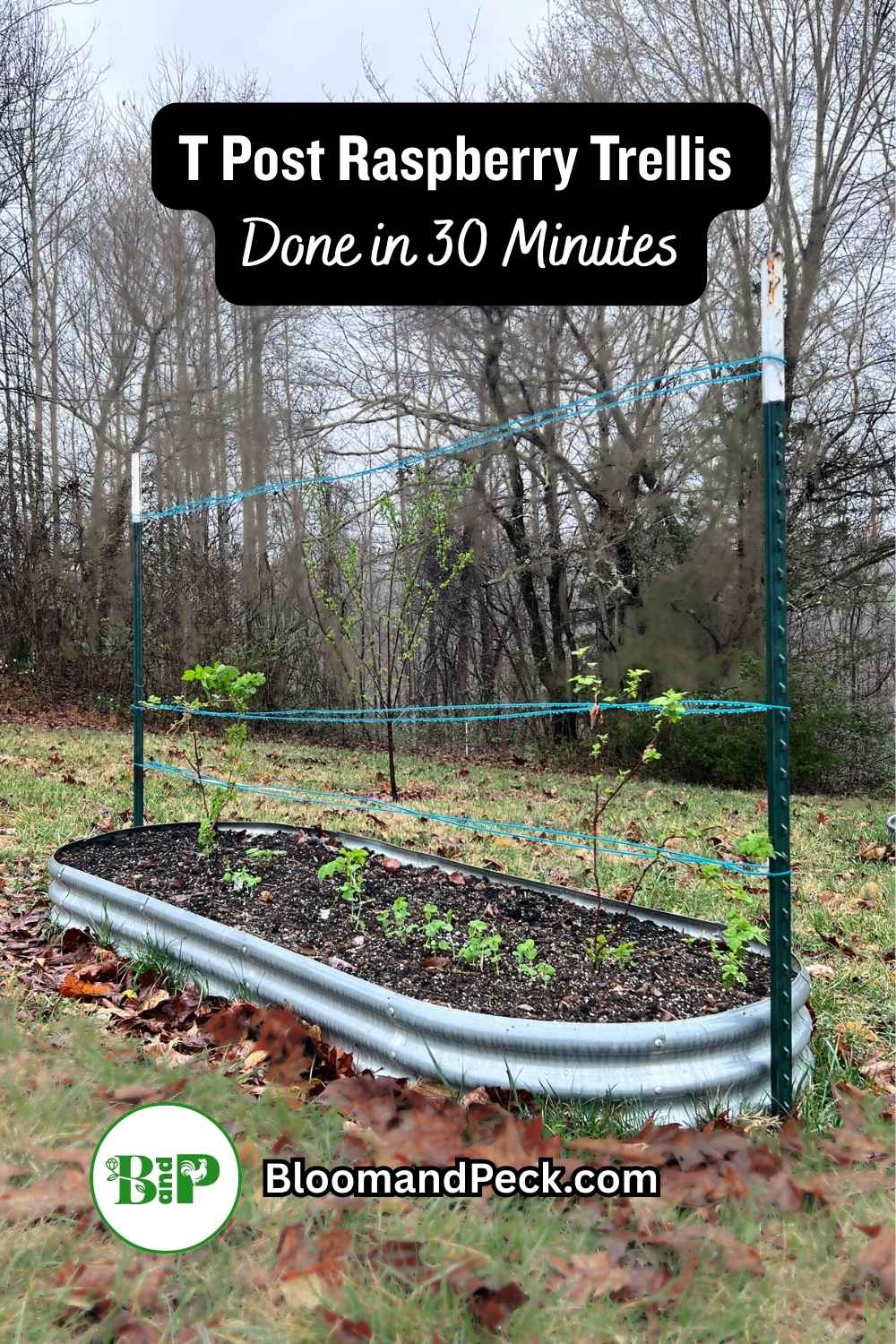
This T-Post Raspberry trellis post is a follow-up to my Transplanting Raspberries to a Raised Bed in Kentucky post. And Part of my Kentucky Raspberry growing series. If you missed my latest post, I transplanted six Tulamagic floricane raspberries into a 3×8 galvanized raised bed on my Zone 7 ridgetop homestead in early March.
Spoiler alter, Ya gotta see the last picture and compare to the one below, these TulaMagic raspberry plants are testing this set up for sure!

June — three months later, canes growing up through the wires exactly as planned. This is why the trellis goes in early, not after. BUT, it is easy enough to lasso per say, the brambles and pull them all into shape with the wires.

If you read my last post, you know I ended it with a promise — the trellis was coming. The raspberries were in the ground, the buds were swelling, and those canes were going to need support sooner rather than later. But true to the homestead life here at Bloom and Peck, I wasn’t going to waste a trip and run to the store for just one thing. I was working with what I had.
Do Raspberries Need a Trellis?
Yes — and especially in a raised bed. Raspberry canes can grow 4–6 feet tall, and without support, they flop, tangle, and become a nightmare to harvest. (You know those plants have pokies!) In a raised bed where you’ve got plants spaced down a narrow center row, unmanaged canes will sprawl out in every direction fast. I just planted these a couple of days ago, and they are already getting bigger! Awesome right?!
A trellis keeps canes upright, improves airflow (which matters a lot in Kentucky’s humidity and helps prevent disease), and makes picking so much easier. It doesn’t have to be fancy — mine definitely isn’t. The nice thing about the 3×8 bed size is It can grow bigger and be flexible to more raspberry plants.
SEE the title below on dimensions for more t post height info.
📏 T Post Raspberry Trellis 3’x8’x12″ Raised Bed Quick Specs
Want the plan in your garden?
Get the complete plan as a free printable PDF to save, print, and take with you.
Get the free one-page T-Post Raspberry Trellis Plan — materials list, all three wire heights, and the step diagram on a single printable page.
No screenshotting the specs table. Print it, check off the materials, build it in 30 minutes. (Plus occasional real-talk Kentucky homesteading tips — no woo-woo, just what works.)

What Kind of Trellis Is Best for Raspberries in a Raised Bed?
I went down a rabbit hole on raspberry trellis ideas after my transplanting post. Seriously, more than 2 cups of coffee worth. There are quite a few systems out there — the I-trellis, V-trellis, T-trellis — but for a simple 3×8 raised bed with 6 plants, I landed on a t post raspberry trellis with wire looping around both posts to form a perimeter around the bed (sometimes called a loop trellis or fence trellis). I picked it because I had most of the materials at hand and I could do it on my own.
The idea is simple: one T-post at each end of the bed, with wire running down both long sides forming a long oval around the plants. The canes grow up through the middle and lean against the wires on either side for support. No complicated crossbars, no fancy hardware, no kit needed.
This isn’t a textbook system — it’s a homestead solution. And it works perfectly for a short raised bed.
What I Used (All Things I Already Had, Mostly)
This build cost me $14 for clothesline wire, because I raided what was already on the property:
- 2 metal T-posts, 7 ft each
- 1 post pounder (you could do this with a Sledgehammer, I’m a clutz, so I opt for the pounder)
- Heavy gauge clothesline (~100 ft)
- Wire cutters
- Pliers for pulling, but not necessary.

That’s it. If you’re starting from scratch, T-posts run about $5–9 each at Tractor Supply hardware or home improvement stores, and a roll of 100ft 10-gauge clothesline wire is under $16. Total build cost from scratch: under $40. You don’t HAVE to have a post pounder, but I would break a leg with a sledgehammer! These things you can probably find on FB craigslist or marketplace too.
T Post Raspberry Trellis Measurements: What Size Do You Need?
For a 3×8 raised bed, here’s what worked for me:
- Post height above soil: 5 feet (worked out to 6.5′ t post) SEE NOTE BELOW – you need to know to subtract 18″ from the post then subtract the 12″ bed height. Which then makes the post 4 1/2 ft above the soil in the bed.
- Lower wire height: 18 inches above soil in bed
- Middle wire height: (I did not find this in reading; my plants just seemed to need the support at this stage)
- Upper wire height: 42–48 inches above soil in bed
- Wire length needed: About 17–18 ft per loop (8 ft each long side + a little extra to wrap the posts)
These raspberry trellis dimensions give you plenty of support for canes that will eventually reach 4–6 feet. If your bed is longer than 8 feet, plan to add a middle post to keep the wire from sagging. If I upgrade plants and bed size, I’ll upgrade the setup to a T-Trellis.
UPDATE: Ok, one thing I did not think about when doing my T posts, because I used what I had. If you are doing this from scratch, see how tall your raspberries will get. Mine are Tulamagic and get 6ft tall and they out grew my smaller posts. Here are some dimensions to consider when putting in your posts. The height of the post above the side of the bed.
| T-post length | Total length | Above ground | Above 12″ raised bed |
|---|---|---|---|
| 6.5 ft | 78″ | 60″ | 48″ (4 ft) |
| 7 ft | 84″ | 66″ | 54″ (4 ft 6 in) |
| 8 ft | 96″ | 78″ | 66″ (5 ft 6 in) |
How to Build a T-Post Raspberry Trellis: Step by Step
Step 1: Pound the T-Posts
Place one T-post centered on each short (3 ft) end of the raised bed. Drive them down, on the outside of the bed, until you have about 5-6 feet of post standing above the soil. The post pounder made quick work of this — even through the Kentucky ridgetop soil. Pound them in at least 18″ or to the top of the t post V shape footer.
Pro tip: T-posts have little metal tabs (nubs) on the face of the post. Make sure they face outside the bed so your wire can rest between them.

Step 2: Run the First Wire Loop
Make a small simple loop and twist the wire on it self (see picture below) Do a simple wrap of wire at the base of one post, run it down one long side of the bed at 18 inches above the soil, loop it around the far post (look for those nubs to hold the wire in place), come back down the other long side, and tie it back where you started — one continuous oval. This lower wire corrals young canes and keeps them off the soil.

Pro tip: T-posts have little metal tabs (nubs) on the face of the post. Hook your wire behind them at each height, and it won’t slide down. Don’t skip this.
Step 3: Run the Second Wire Loop
This is where I deviated from the norm. My plants are not strong, yet I felt I should make 3 wires to train them.
So my second wire is about 28″ As my pot-growing Tula Magic raspberry plants are not super straight or thick canes, as of yet.
Step 3 Third Wire: Same process at 42–48 inches above the soil. This is your main load-bearing wire.

Step 4: Tension Wire
Hand tension is completely fine for an 8 ft span. No turnbuckles needed. I used pliers to pull the wires tight and looped the wire through and wrapped the extra back on itself. I can tighten and move the wires to adjust them as needed.
Step 5: Tuck raspberry plants into the wire perimeter
Carefully tuck the canes of the berry plants between the perimeter wires. The wires help support the canes as they grow. This keeps the berry vines from sprawling all over, keeping them healthy.

End of Project:
The whole thing took about 30 minutes, including time spent wrangling the clothesline spool. That stuff will come unraveled and tangles like it hates you. I tried to shoot a video and did not pay attention to my wire, took me 5 min to get it all rolled up again. Opps!
Pro tip I learned the hard way — unroll a generous length of clothesline in a straight line with the roll always in your hand BEFORE you start running it around the posts. Give yourself some slack to work with and the spool stays manageable.
How the Budget T Post Raspberry Trellis Looks and Works
The finished t post raspberry trellis creates a long oval frame around the bed. As the Tula Magic canes grow taller, I tuck them behind the wires or tie loosely with jute twine. Airflow through the bed is good, I can walk both sides to harvest, and nothing is flopping into the path.

For six plants in a 3×8 bed, this is plenty. A longer bed would require a middle post for wire support.
Raspberry T Post Trellis Pictures In Full Growth


I did not expect the plants to spread this much in just the few months from planting. These 3 plants were planted in April 2026 this is June 2026. I will mostly either thin them for possible powdery mildew or make a V shape next.
July Update, I have been using that pest cloth you can see in the background, the raspberry plants have grown above the T Posts, which is awesome. But not awesome for my shade cloth. I haven’t found a Tree mesh bag that will fit around the raised bed, so I will most likely have to figure out how to do that! But for now I am going to put two 8ft post on the ends and that will be the “tent” for the shade cloth. Will update with pictures soon!
What I Might Change
A few things I’m watching:
🌻 Post Height– I started with 6′ posts, I think I may change it up to the 8ft post so I can cover the berry plants with shade cloth or row cover cloth to help prevent against pest and sun damage (I use shade cloth and for easy I may update these to 8ft post I found at Rural King)
🌻 Wire height — With this easy setup, I am able to move the wires up and down in a couple of minutes. I can move them to whatever height the raspberry plants need support.
🌻 Clothesline durability —Some homesteaders swear by baling twine as an alternative — cheap, easy to restring, and holds up 2–3 seasons. My issue here is that I honestly wanted it to look a little better and last longer. I’ll report back.
🌻 Tension – I may add turnbuckles if I can find some on budget to help tighten the wire. It is very thick at 10 gauge, and if I run it into another raised bed, I will definitely need more wire tension to support the raspberry plants.
What’s Next for the Raspberry Bed
Now that the trellis is up, the next project is shade cloth before the Kentucky summer hits — Tula Magic does not love the heat of the Kentucky full afternoon sun. I’ll also be putting in some living mulch (thyme and nasturtium along the edges). (I already put some peas in because my other garden bed wasn’t ready) I am again deep diving on what is going to look ok, cost less, and prevent a few issues I found last year in my potted raspberry plants. Links coming as soon as those posts are up.
Frequently Asked Questions: T Post Raspberry Trellis
Yes. Without support, raspberry canes flop, tangle, and are hard to harvest. A simple trellis keeps canes upright, improves airflow, and makes berry picking much easier — especially in humid climates like Kentucky.
For a home raised bed, a simple t post raspberry trellis with two wire loops is the easiest and most affordable option. For larger in-ground rows, a V-trellis or I-trellis gives better cane separation and light exposure. See references below for more details
For a 3×8 bed: posts at 5 ft above soil, lower wire at 18 inches, upper wire at 42–48 inches. For a longer bed, add a middle post and keep wire spans under 10 ft to prevent sagging.
12.5 or 14 gauge galvanized wire is the standard recommendation and holds up well outdoors. I opted for the coated 10-gauge clothes line wire, it’s super strong, budget-friendly, and I did not break it when twisting like hot wire. Baling twine is a popular budget option for the lower wire.
Use 6–7 ft T-posts so you end up with at least 5 ft of post above the soil after setting them. Raspberry canes reach 4–6 ft tall at maturity.
Not necessarily. You can pound them into the bed soil or bolt them to the inside of a wooden bed frame. For a short 8 ft bed, the wire tension is low enough that secure placement in the soil is plenty.
Hook the wire behind the metal tabs (nubs) molded into the face of the T-post at your target height. These are designed exactly for this and lock the wire in place without any clips.
Sources & Further Reading
- NC State Extension — Trellis Systems for Caneberries
- University of Kentucky Extension — Growing Blackberries & Raspberries in Kentucky HO-15
- Growing Fruit Community — Raspberry Trellis Systems
Growing Raspberries in Kentucky on a budget? Drop your trellis builds or comments below, I’d love to or hear about what you built!
Leave a Reply