
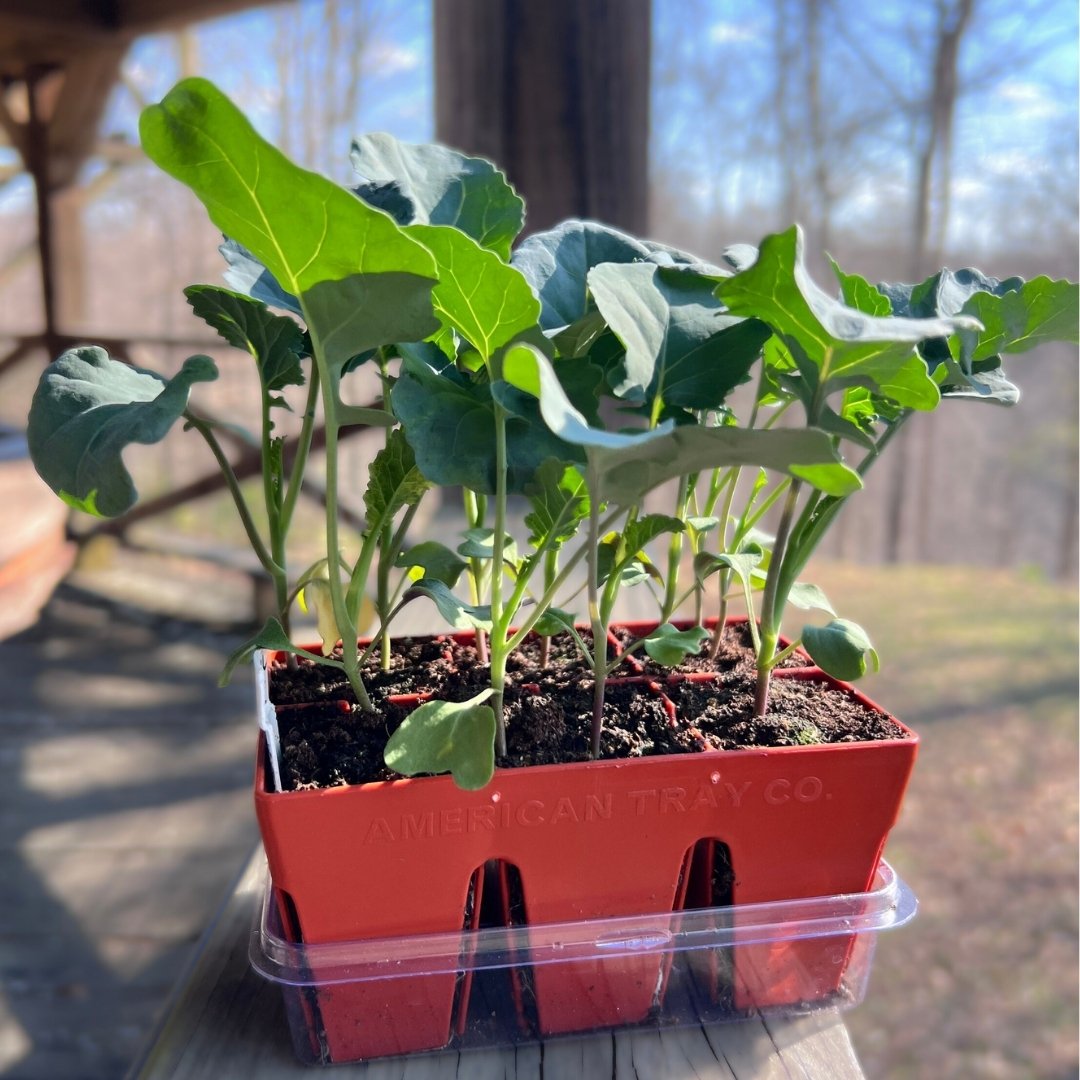
Last year I grew broccoli. The worms grew it with me. This year, when to plant Broccoli in Kentucky has taken on a new meaning, win against the worms.
I planted Calabrese and Waltham 29 — both solid Kentucky varieties — and felt pretty good about it. Then I turned over a leaf one morning and found what I can only describe as a small green army. Cabbage loopers. Imported cabbage worm. All of them were very happy, very hungry, and completely at home on my broccoli.
I didn’t lose everything, but I lost enough to take it personally.
This year I’m back with a plan. Di Cicco heirloom broccoli, a freshly tilled and amended dirt-raised bed, onions interplanted as companions, and row cover going on from day one. I grew broccoli in both spring and fall last year — enough to know what went wrong and what I’m doing differently.

This is what I know about when to plant broccoli in Kentucky, what actually works in our climate, and how to keep the worms from winning.
From my homestead: I garden in Zone 7a in western Kentucky. My broccoli goes into a tilled and amended dirt raised bed this year — not a perfect galvanized setup, I wish I had more, just good soil mounded and compost worked in. Work with what you have!
This post contains affiliate links. If you purchase through my links I may earn a small commission at no extra cost to you. I only share products I actually use in my own garden.
When to Plant Broccoli In Kentucky
Broccoli is a cool-season crop that should be planted twice a year in Kentucky.
- Start seeds indoors: late February–March
- Transplant outside: early April
- Start fall seeds: July
See the Fall Kentucky Garden Guide Here - Transplant for fall: early August
- Best harvest: fall (more reliable)
See the table below for exact Kentucky zone dates
Broccoli Planting Dates for Kentucky (Zone 6–7)
Broccoli is a cool-season crop — it belongs to the same family as cabbage, cauliflower, and kale, which the UK Extension calls cole crops. It grows best when temperatures stay below 80°F, which gives us two windows in Kentucky: spring and fall.
And here’s something worth knowing upfront: They say fall broccoli is actually better quality than spring broccoli in Kentucky. The UK Cooperative Extension confirms this — broccoli florets maturing in cool fall temperatures are tighter, sweeter, and of better quality than ones rushing to finish before summer heat. I missed the spring window last year so getting them in the ground this year!
Most Kentucky gardeners only think about spring planting. Growing both seasons doubles your harvest and gives you a second chance if spring doesn’t go the way you planned.
This is a close estimate according to the University of Kentucky Extention. I do recommend searching your zip code with a tool like the Farmers’ Almanac Here. For spring, set out transplants 4-6 weeks before the last frost, and for fall, plant transplants 6-8 weeks before the first hard frost.
| Crop | Western KY (Zone 7a/7b) | Central KY (Zone 7a) | Eastern KY (Zone 6b) | Notes |
| 🥦 Spring — | 🥦 Spring — Earliest Safe Transplant Date (plants into garden) | 🥦 Spring — Earliest Safe Transplant Date (plants into garden) | 🥦 Spring — Earliest Safe Transplant Date (plants into garden) | 🥦 Spring — |
| Broccoli (plants) | April 1 | Apr 8 | Apr 15 | Cold tolerant, handles light frost |
| Cabbage (plants) | April 1 | Apr 8 | Apr 15 | Same family as broccoli |
| Cauliflower (plants) | April 1 | Apr 8 | Fall quality is superior in KY | Less frost tolerant than broccoli |
| 🍂 Fall — | 🍂 Fall — Transplant Date (plants into permanent location) | 🍂 Fall — Transplant Date (plants into permanent location) | 🍂 Fall — Transplant Date (plants into permanent location) | 🍂 Fall — |
| Broccoli (plants) | Aug 1 | Aug 8 | Aug 15 | Fall quality superior in KY |
| Cabbage (plants) | Aug 1 | Aug 8 | Aug 15 | |
| Cauliflower (plants) | Aug 1 | Aug 8 | Aug 15 |
Tip: Broccoli does best when started as transplants, not direct-seeded. Either buy transplants from a local nursery or start your own indoors 4–6 weeks before your outdoor planting date.
Want more real Kentucky Garden trial and errors? I will update you with what happens in my Kentucky garden and homestead.
From my homestead, I’m putting my Di Cicco transplants in about April 7th according to my zipcode in Zone 7a. For the fall garden I’m looking at Comet — a reliable heading variety that does well in Kentucky fall conditions. I’ll update this post when I decide.
Looking for more Kentucky Garden Info? Check out my Gardening Hub page I update when I learn and grow new things!
Which Broccoli Variety Should You Grow in Kentucky?
There are more broccoli varieties than most beginners realize, and the right choice depends on what you want from the plant.
Heading varieties — one main harvest
- Calabrese — what I grew last year. A classic Italian heading broccoli, reliable, good sized heads. Does well in Kentucky spring.
- Waltham 29 — also from last year. Open-pollinated, dependable, a Kentucky garden staple. Good for fall.
- Comet — my planned fall variety this year. Disease resistant and does well in our fall conditions.
- Marathon — cold tolerant, UK Extension recommended for early spring planting in Kentucky.
- Emerald Crown — UK Extension recommends this specifically for Kentucky fall growing. Larger head on a short plant. (I found this variety at the Amish Market stand in Liberty. It really was delicious)

Di Cicco — the variety I’m growing this spring because of the fast 48 day maturing window, along with the Heirloom quality. Fall I will either try Comet or Emerald Crown. And update you with how that grows too.
Di Cicco is an heirloom Italian variety that produces a small main head — about 3 to 4 inches — followed by a long season of side shoot spears. Once you cut the main head, the plant keeps producing smaller shoots for weeks. That means a much longer harvest window than a single-cut heading variety.
- Days to maturity: around 48 days to the main head
- Side shoots: continue producing well after the main head is cut — pinching the main shoot encourages even heavier side shoot production
- Heirloom: open pollinated, you can save seeds
- Best for: gardeners who want a longer harvest season and don’t need uniform, large heads
From my homestead: I chose Di Cicco specifically because of those side shoots. This year I want the plant working longer for me — especially with the time I’m putting into soil prep and pest management. (Hopefully the heat won’t get them too soon!)
Update on Di Cicco. This stuff is a monster! I can’t believe how big it got! and It kept growing into July until I finally pulled it after I left the cover off and it got bug damage. The side shoots were wonderful. I will be using this row cover companion planting set up from now on. Keep reading to see what I did and what I’d change.

Tip: If you’re a first-time broccoli grower and want something more predictable, start with Calabrese or Waltham 29. Di Cicco is wonderful but the non-uniform maturity means it looks different from what you might expect. I picked side shoots through mid July on the spring planting until It started to bolt when the heat hit over 90 for a week straight.
What the package doesn’t tell you about De Cicco is it spreads wide and is very dense.
The Real Problem with Growing Broccoli in Kentucky: The Worms
I’m going to spend some time on this because it’s the reason most Kentucky gardeners give up on broccoli after the first year. The worms are real and they are committed.
There are two main culprits, according to the UK Extension (but there are many):
- Imported cabbageworm — the caterpillar of a white butterfly. If you see small white butterflies floating around your garden during the day, they are laying eggs on your broccoli leaves. The eggs hatch into green caterpillars that blend in perfectly with the plant and eat entire leaves.
- Cabbage looper — comes from a dark moth that lays eggs at night. Another green caterpillar, another reason to check the undersides of your leaves regularly.
Both are green. Each hides on the undersides of leaves. Both will eat your broccoli to the stems if you let them get established.

From my Kentucky homestead: Last year I spotted the damage before I spotted the worms. By the time I found the cabbage looper, they were already well settled in. I lost a good chunk of leaf coverage before I got things under control. This year, I’m not waiting for damage — I’m preventing it from the start.

My plan this year: onions, thyme, leaf mulch, and row cover
I’m taking a two-layer approach this season based on what I learned the hard way.
- Interplanting with onions — onions are being planted alongside my broccoli this spring while my polytunnel is going up and they need a home. The strong scent of onions is thought to confuse and deter the white cabbage worm butterflies from landing and laying eggs. This is my first year trying this combination intentionally — I’ll report back on whether it works.

- Row cover from day one — this is the most reliable physical barrier against egg-laying butterflies and moths. A lightweight floating row cover lets in light and water but keeps insects off the plants. Going on at planting, not after damage appears.
UPDATE: The row cover made all the difference with the bugs eating my broccoli. My mistake was the De Cicco I grew did so well it out grew the bed and 3 foot stakes you see in the picture below.

- I decided to also add Thyme plants I grew this year from seed to the broccoli bed. It is also known to deter cabbage worms!
Tip: Turn leaves over every few days and look for small white or yellow eggs — catching them before they hatch is much easier than dealing with established caterpillars. Squish what you find.
Companion planting with onions fits into my broader Kentucky companion planting approach — you can read more about how I think about companions in the garden here: Kentucky Companion Planting→ bloomandpeck.com/kentucky-companion-planting/
How to Plant Broccoli in Kentucky
Transplants vs direct seeding
Broccoli does best transplanted into the garden as young plants rather than direct seeded. You can either buy transplants from a local nursery — which is the easiest option for beginners — or start your own indoors 4 to 6 weeks before your outdoor planting date.
Tip: If you’re buying transplants, look for stocky plants with thick stems. Leggy, tall transplants have been stretching for light and don’t establish as well.

Spacing (more pictures coming after April 7th) Updated 4-8-2026
Give broccoli room — plants need 18 to 24 inches apart in a row. I know it looks sparse when you first plant them, but broccoli gets big and needs airflow, especially in Kentucky’s humid conditions. (Powdery Mildew is Real)
UPDATE: the De Cicoo broccoli needed way more space then the suggested 18″ and It really needed a 4ft wide bed to accommodate the onions on the sides. I am going to try another variety in the fall garden to see if the space needs adjustment for variety.

To get my spacing close to straight, I ran lines down my 3’wide by 22′ raised garden bed. This helped me keep a nice straight row of broccoli and onions. Why do this? It will help with airflow and give me space to run watering lines when I get those set up.

Soil prep
Broccoli is a heavy feeder. It rewards good soil preparation with bigger heads and stronger plants. I tilled and amended my bed this year specifically for this planting — worked in compost to improve both nutrition and water retention.
From my homestead: Last year, my broccoli near the potato bed didn’t get enough water, and the plants struggled. The ones in the raised bed with better water and extra fertilizer did noticeably better. Consistent moisture and nutrition make a real difference with broccoli — don’t skip it.
Tip: Broccoli likes a soil pH of 6.0 to 7.0. If you haven’t tested your soil in a few years your local UK Extension office can test it for you cheaply.
The dirt raised bed
My broccoli this year is going into a mound bed or a dirt raised bed — not a framed galvanized structure-though I do use them, just a tilled, amended, mounded area of good soil. On my ridge top homestead, this takes a little more effort, because I have to pick all the rocks out as I go. But it drains better than flat ground, warms up faster in spring, and gives the roots good, loose soil to establish in.

You don’t need a fancy setup to grow good broccoli. Start with good soil, consistent water, and a plan for the worms. You could even grow broccoli in containers if you don’t have space.

Hmmm, should I try one and show what happens? let me know in the comments if you’d like to see what happens in a container set up.
Spring vs Fall Broccoli in Kentucky — Which is Better?
Grow both if you can. But if I had to choose one based on last year’s experience — fall wins.
- Spring broccoli — you’re racing the heat. Plant early, hope for a cool May, harvest before June heat causes the heads to bolt and flower. It’s doable but you’re working against the clock.
- Fall broccoli — you’re working with the weather. Transplant in July, the plant grows through August heat, and then the heads mature in September and October as temperatures cool. The UK Extension specifically notes that fall broccoli quality in Kentucky is superior to spring. Tighter heads, better flavor, less worm pressure as temperatures drop.
There’s nothing more frustrating than waiting on a perfect broccoli head… only for Kentucky to hit you with an 80° day in April and your plant says ‘I’m done here.’ Been there.
Harvesting Broccoli
The main head is ready when it’s about 3 to 6 inches across and the buds are tight and dark green. Cut it 5 to 6 inches down the stem — don’t pull the plant.
Here’s the part beginners like me sometimes don’t know: after you cut the main head, the plant keeps producing. Smaller side shoots will develop from the stem and can be harvested over several more weeks. Some varieties do it better than others. With Di Cicco, this side shoot production is my endgame for longer fresh broccoli on the table — the main head is almost secondary. I will post pictures as it grows.
- Harvest before buds open into yellow flowers — once it flowers the broccoli is no longer good to eat.
- Check daily once heads form — broccoli can go from perfect to flowering faster than you’d expect in warm weather.
- Side shoots will be 1 to 3 inches — harvest them regularly to keep the plant producing.
Tip: Broccoli is best eaten the day it’s picked. If you’re storing it, keep unwashed in the refrigerator for up to two weeks.
Will broccoli keep producing?
Yes—most broccoli will give you more than one harvest.
After you cut the main head, your plant will often send out smaller side shoots from the leaf joints along the stem. These won’t be as big as the main head, but they’re tender, delicious, and honestly… feel like bonus broccoli you didn’t even plan for.
In my Kentucky garden, this is where broccoli really earns its space.
How to get more side shoots:
- Cut the main head before it starts to loosen or flower
- Leave a few inches of stem when harvesting
- Keep watering consistently (Kentucky heat dries things out fast)
- Harvest often—this tells the plant to keep producing
Important:
Some varieties produce more side shoots than others. If you want a longer harvest, look for types labeled “sprouting” or “side-shooting.”
FAQ — When to Plant Broccoli in Kentucky
Yes — mid to late March is the right window for most of Kentucky. Zone 7a gardeners can transplant by mid-March. Zone 6a should wait until late March or early April. Broccoli is cold tolerant and can handle light frost, but transplants need to be hardened off before going outside.
Early April is fine for Zone 6a. For Zone 7a, early April is pushing it for spring . Choose varieties with short maturity windows— can plant as early as you can in spring and plan a fall planting as a backup.
This is called bolting and it happens when temperatures get too warm too fast. In Kentucky this is a common spring problem. Plant early to avoid it, and if your spring gets warm quickly, harvest the head even if it’s smaller than you’d like — a small tight head is better than a flowering one.
The two main culprits are the imported cabbageworm and the cabbage looper. Check the undersides of leaves every few days and squish any eggs or caterpillars you find. A lightweight row cover installed at planting prevents the butterflies and moths from laying eggs in the first place. Some gardeners use Bt (Bacillus thuringiensis), an organic spray that targets caterpillars specifically without harming other insects.
Both if possible — but fall broccoli actually produces better quality heads in Kentucky. The UK Extension confirms that broccoli maturing in cool fall temperatures is superior to spring broccoli. For fall, transplant in July and harvest September through October.
Absolutely — raised beds are ideal for broccoli in Kentucky because they drain well, warm up faster in spring, and make it easier to manage soil quality. Even a simple tilled and mounded dirt bed works well. Just make sure you have good amended soil and consistent water.
Back in the Garden, Better Prepared
The worms won a few rounds last year. But that’s how homesteading goes — you learn what your garden needs by growing in it, failing in it, and coming back the next season with a better plan.
This year the Di Cicco is going in with onions alongside it and row cover over it from day one. The bed is prepped, the soil is amended, and I know what I’m looking for on the undersides of those leaves.
Broccoli is worth the effort. Especially in fall. Especially fresh from your own Kentucky garden.
Update: YES, The row cover and companion planting worked so well I will do this set up every year and I am going to use it on the cabbage too!
Happy growing,
Bloom & Peck Farm
Resources & Further Reading
- UK Cooperative Extension — Growing Broccoli Guide (NEP-225): publications.mgcafe.uky.edu/sites/publications.ca.uky.edu/files/NEP225.pdf
- UK Cooperative Extension — Home Vegetable Gardening in Kentucky (ID-128): publications.mgcafe.uky.edu/files/ID128.pdf
- UK Cooperative Extension — Kentucky Garden Calendar: planeatmove.com/wp-content/uploads/2025/06/NEP_GARDEN_calendar_printable2025_2.pdf
More From Bloom & Peck Farm
- When to Plant Peas in Kentucky → bloomandpeck.com/when-to-plant-peas-kentucky/
- When to Plant Cucumbers in Kentucky → bloomandpeck.com/how-to-grow-cucumbers-in-kentucky/
- Kentucky Companion Planting Guide → bloomandpeck.com/kentucky-companion-planting/
- Growing Raspberries in Kentucky → bloomandpeck.com/raspberry-revival-story-of-growing-tulamagic-with-intercropping/
- Kentucky Gardening Hub → bloomandpeck.com/kentucky-gardening/
Leave a Reply