
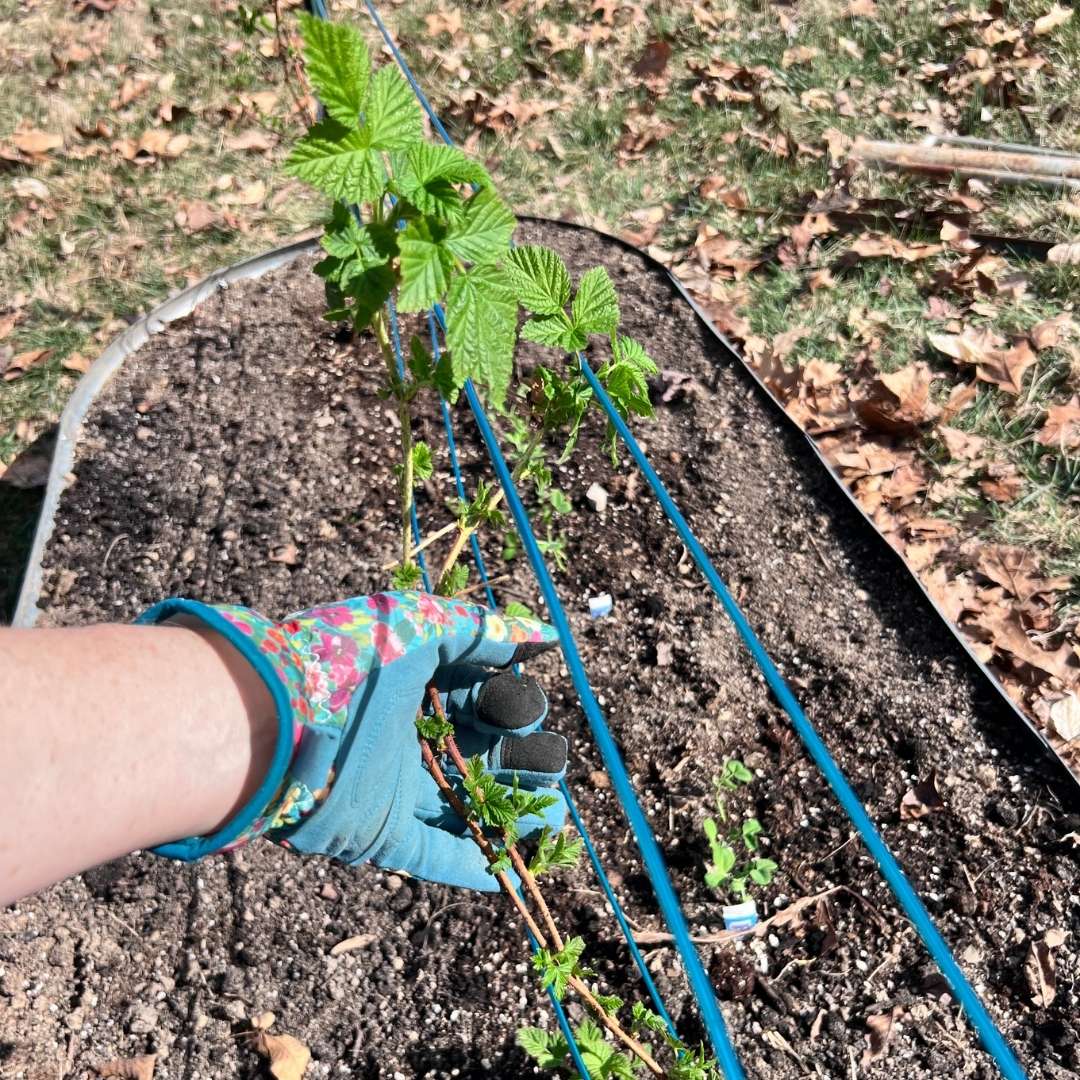
Hello, fellow growers! 🌱 This is my full-season journal of growing TulaMagic raspberries in Kentucky’s Zone 7 — the containers, the raised beds, the trellis, the pests, and what actually survives a Kentucky summer.
It started in late February 2025 as a birthday gift to myself: I ordered TulaMagic raspberries from Holland Bulb Farms (grown in the USA) with a 10%-off coupon. Everything here is updated through 2026 as the plants grow.
What Is a Tula Magic Raspberry? (And Why I Grew It Instead of Tulameen)
Here’s the honest origin story: I actually wanted Tulameen, my favorite from out west — but I couldn’t find plants, they ran about $20 each, and my reading suggested Kentucky’s heat would punish them. So I went looking for something tougher and landed on TulaMagic, and the more I read, the more it won me over. NOTE: I ordered from Holland bulbs Farms and 3 out of the 6 survived the first year.
In plain terms, TulaMagic is a newer mid-season, summer-fruiting (floricane) red raspberry bred in Switzerland from a cross of Autumn Bliss × Tulameen. It’s described as vigorous, with firm, medium-to-large light-red fruit, and — the part that sold me for our wet Kentucky clay — it’s reported to have some tolerance to Phytophthora root rot, the disease that kills raspberries in soggy ground. It may even push a little primocane fruit under tunnels. (Variety details paraphrased from Ohio State’s raspberry cultivar notes; link as a source.)
That root-rot tolerance is a big deal here, and it’s why I stopped mourning the Tulameen and started rooting for the TulaMagic.
Direct Quote: “Tulamagic (Switzerland, Autumn Bliss X Tulameen). This is a very new mid-season floricane fruiting type from Europe that is reported to have firm, medium to large fruit with a light red color. Plants are vigorous and may tolerate Phytophthora root rot. May produce some primocane fruit in tunnels.” Link to Source
Does Kentucky Actually Recommend TulaMagic? (What UK Extension Says)
Short answer: not by name — and here’s why I am going with that’s fine.
University of Kentucky’s bramble guide (HO-15) is the go-to list for what grows here, and it recommends proven red raspberries like Latham, Canby, Reveille, and Titan among the summer-bearers, plus everbearers like Heritage, Redwing, and Caroline.
TulaMagic isn’t on it — but that list dates to 2005, and TulaMagic is a newer European variety that simply came along after it was written. So its absence isn’t a red flag; it’s a calendar gap. It is on Cornell University and OSU Sites.
And here’s the reassuring part I found digging through UK’s own trial notes: Autumn Bliss — one of TulaMagic’s two parents — “performed very well” in Kentucky cultivar trials. So half of TulaMagic’s parentage is already Kentucky-proven. I’m growing an off-list variety, but not a wild gamble. (Source: UK Cooperative Extension, HO-15, “Growing Blackberries & Raspberries in Kentucky.”)
The Series: Growing Tula Magic in Kentucky, Step by Step
This hub ties together the whole journey. Here’s the path, in order — each one is its own full post:


What Kentucky Throws at You (a Quick Field Guide)
Growing raspberries here means managing a few very Kentucky problems. Here’s the short version — I go deep on each in the linked posts:
- Root rot from wet clay → I fight it with raised beds (and TulaMagic’s own tolerance). So far, so good. (More in the transplanting post ».)
- Cane borers — the rednecked and raspberry cane borers are a real Kentucky bramble pest, and they hit young plantings hardest, which is exactly what mine are. The fix is watching for wilted tips and swollen galls and pruning out the affected canes. (Full pest breakdown in the orchard post ».)
- Japanese beetles → they swarm the whole orchard in July heat. (Also in the orchard post ».)
- Sunscald — fruit and canes can burn above about 90°F in intense sun, so I sited the bed for afternoon shade and I’m testing row cover. (The shade strategy is the spine of the orchard post ».)
- Vigor — nobody warned me. Planted in April, by late July three plants had filled the 3×8 bed and shot past the 6.5-ft trellis. Taller posts are next. (See the trellis post ».)
How I Grow Them (the Extension-Backed Basics)
Pulling from UK Extension guidance, here’s the short playbook I’m following:
- Transplant late March through early April — early planting yields better the first year.
- Site for afternoon shade — UK recommends it; cooler, moister soil and less scorch.
- Use raised beds — they help fight root rot and prolong the planting.
- Well-drained, fertile soil with mulch — raspberries hate wet feet.
- Trickle irrigation — recommended; I don’t have mine set up yet, but it’s on the list.
(Sources: UK Extension — HO-15; NEP-247 beginner raspberry guide; and UK’s “time to plant brambles” guidance.)

A Kentucky Zone 7 Homesteader’s Take
I dreamed of weaving these into a food-forest planting with the apples and plums — and I mostly have, just not the way the textbooks draw it. They live in a metal 3×8 raised bed for three honest reasons: my husband would mow them down without a border, they spread worse than mint 😅, and — always — the fear of root rot. It’s working so far: I started 2025 with three plants, and in 2026 there are a lot more. The full story of how it all fits together is in the orchard post ».
References:
https://entomology.mgcafe.uky.edu/ef209
https://fruitscout.mgcafe.uky.edu/sunscald-or-sunburn-brambles
https://publications.mgcafe.uky.edu/sites/publications.ca.uky.edu/files/ho15.pdf