
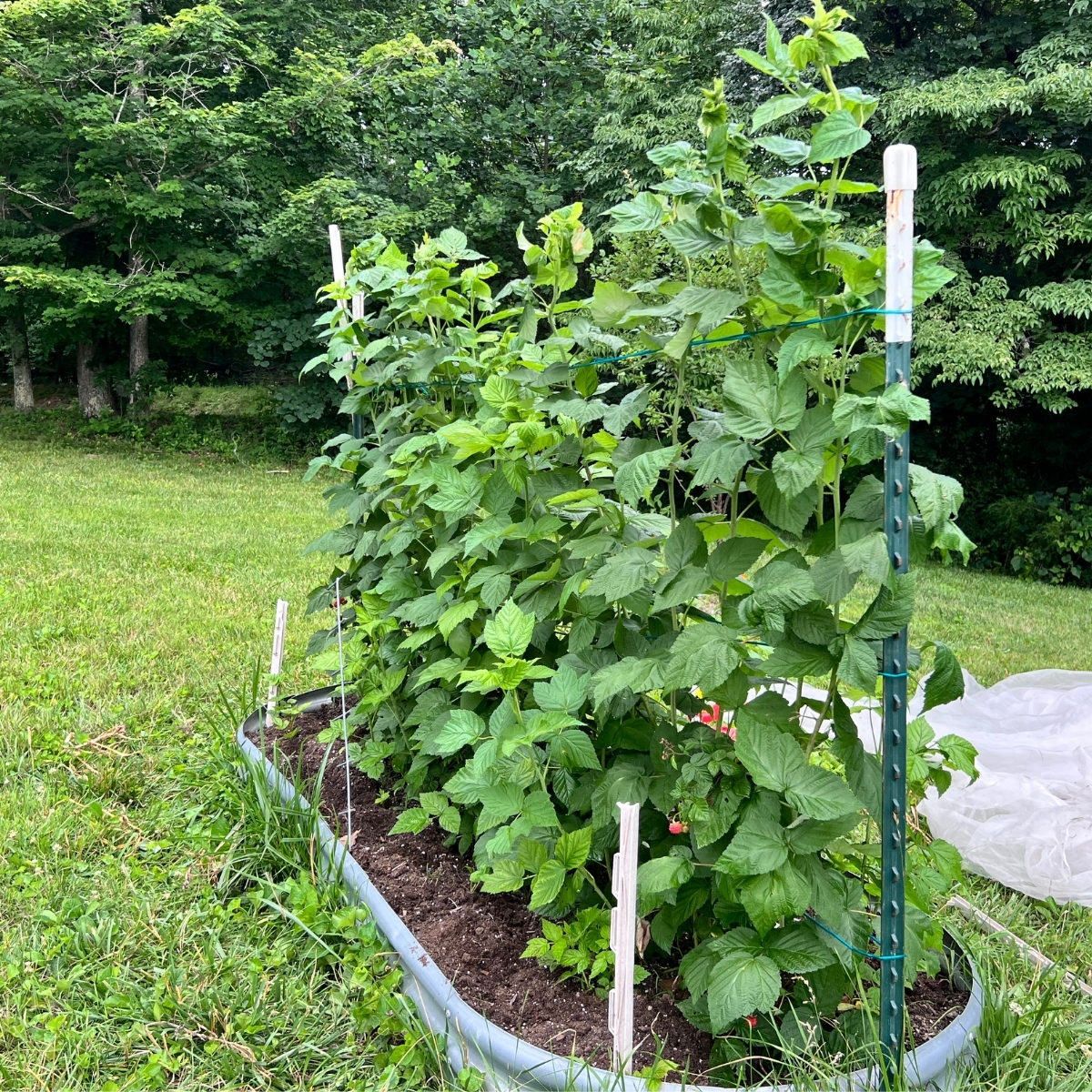
Hello, fellow growers! 🌱 On the Kentucky Ridgetop, I grow my raspberries in a raised bed set among my fruit trees — with the pollinator plants in their own raised beds nearby, and mowed grass lanes between everything so we can actually keep it tidy.
I did a lot of reading about fruit tree guilds first (that permaculture idea where you ring a tree with companions), but I looked at my life, my mower, and my back and built something simpler on purpose. Here’s the layout, why I chose raised beds over a classic guild, how the woodland edge keeps my raspberries from cooking, and what’s thriving (and swarming) so far.
(Want the story of how I chose this variety and nursed it from five sticks in paper cups? That’s in my main raspberry-growing hub » and my container-gardening post ». This one’s about the layout.)

Disclosure: I get a small commission if you buy through my links at no extra cost to you.
How My Fruit Tree Guild Became Raised Beds
Here’s the honest story: I wanted a fruit tree guild. You know the picture — a fruit tree with a tidy circle of companions tucked in around it, daffodils and garlic and rhubarb all doing their jobs right up against the trunk. I read about them, I dreamed about them, I could see the whole thing.
And then real life had opinions. 😅 A guild means everything’s planted in tight around the tree — which also means there’s no clean way to mow, string-trim, or even walk in without trampling something. Add my back (and the surgery), add a husband with a mower who will absolutely level anything without a border, add the fact that raspberries spread worse than mint — and my neat little guild was going to become an unmowable tangle by August.
So I made a tradeoff — the guild dream, rebuilt for real life. The trees stand in their row. The companions live in their own raised-bed rings, and the raspberries in their own raised bed, with mowed lanes between all of it. I still get most of what I wanted from a guild — pollinators, pest confusion, diversity, a berry layer — but now it’s something we can actually maintain quickly instead of fighting all summer. Not the textbook version. The version that survives contact with my chaotic Kentucky life.

The Woodland Edge Does the Hard Work: Afternoon Shade
Here’s the site decision I made with Sun in mind. We’re surrounded a forest edge, and I placed the orchard so it gets good morning sun and then late afternoon shade from that tree line once the heat cranks up. 🌞➡️🌳
Most raspberry guides say full sun, full stop — and in a cool climate, they’re right. But in Kentucky’s Zone 7, a July afternoon will scorch canes and bleach fruit right on the plant. I talk more about that on my raspberry hub page. So I’m using the woodland edge as free, mature shade — something my young orchard trees can’t provide yet and won’t for years.
And here’s the part that made me feel a lot better about going against the “full sun” crowd: it’s not just my hunch. University of Kentucky Extension actually recommends it. Their bramble guide (HO-15) advises planting on a north-facing slope or somewhere with afternoon shade, because those spots stay cooler and hold moisture better — exactly the problem I’m solving down here. So if a Zone 7 gardener tells you raspberries need blazing all-day sun, you can gently point them to the Extension office. (Source: UK Cooperative Extension, HO-15, “Growing Blackberries & Raspberries in Kentucky.”)
One honest thing on planting this close to the trees and holler: Deer and some of the trees bring pests like Japanese Beetles. In Kentucky, you need to get to know the entomology department quick. So the tree line that saves my berries from scorch also feeds some of the critters and pests that call it home. Gardening is always a negotiation. 😅
I don’t negotiate with terrorists! My idea is to put up a deer fence that does double duty as a chicken run. The thoughts are the chickens eat the larva of the beetles and other pests and help reduce them naturally.
Why Everything’s in Raised Beds
Beyond mowability, the raised beds earn their keep three ways: I can amend the soil in each one (our native clay is a whole other post), the edges stay crisp so the planting reads as intentional instead of chaos, and I can place beds wherever the sun and shade work rather than being locked to where a tree happens to stand. The pollinator beds are literal round rings that I scavenged at a sale; the raspberries are in a 3×8.
Turns out this one’s Extension-backed too. UK’s HO-15 notes that planting brambles on raised beds can help reduce root rot and prolong the life of the planting — raspberries famously hate wet feet, and our Kentucky clay holds water. So a decision I made mostly so my husband could mow is also protecting the plants from crown rot. I’ll take the accidental win. (Source: UK Cooperative Extension, HO-15.)

If you are deciding on raised beds I recommend the Epic Gardening bed, I like the 15″ height for raspberry plants. The bed in the picture is one I was gifted and I have to strengthen the sides with rebar and stakes. You don’t have to do this with the stronger Epic Beds.
The Companions (in Their Rings and Beds)
The supporting cast and the jobs they do — living in their own beds, not crowded around the trunks:
- 🌼 Daffodils — early pollinator forage; the bulbs help discourage voles. I haven’t moved these yet, still around the trees getting mowed down.
- 🧄 Garlic & chives — allium pest-confusers; chives feed pollinators when they bloom.
- 🪻 Bloomerang Lilac– brings in the friendly bees.
- 🌿 Rhubarb — a big leafy perennial that holds a bed and shades out weeds.
- 🧡 Marigolds — pollinator draw, pest confusion.
- 💠Sea Holly– The pollinators of all shapes and kinds love this and it attracts the kinds that eat bad insects too.
- 🫐 TulaMagic raspberries — the productive berry layer, in their shaded bed.
The Pests I’m Actually Fighting (Both of Them)
Two showed up, and they’re completely different battles.
Japanese beetles
The villains right now. 😤 They swarm in the July heat — all over the oaks, the orchard trees, and right onto the raspberry canes — and skeletonize foliage fast. This isn’t just my bad luck, either: UK Extension specifically names Japanese beetles as a bramble pest that’s a problem in central and eastern Kentucky, which is exactly where I am. [ADD your real approach: hand-picking into soapy water in the cool morning when they’re sluggish? And note if you skip pheromone traps, since traps famously draw in MORE beetles than they catch.] (For control, UK points to their fact sheet ENT-5, “The Japanese Beetle.”)

Raspberry & rednecked cane borers (the ones I was warned about)
Worth watching, especially on young plants like mine. UK’s cane-borer fact sheet (ENTFACT-209) describes two: the raspberry cane borer, which leaves a telltale double ring of punctures below the tip and wilts the growing shoots, and the rednecked cane borer, which forms swollen galls on the canes and can hit a big share of the canes in a one- or two-year-old planting — which is exactly what mine are right now. The organic fix for both is the same and it’s free: prune out and burn the affected canes (below the girdle or gall). I think I have these on one cane, I have sent pics to my extension agent for confirmation. (Source: UK Entomology, ENTFACT-209.)
Spotted Wing Drosophila (SWD)
This vinegar-fly cousin hit our region around 2012 and changed soft fruit for everyone, because unlike normal fruit flies it lays eggs in ripening berries, not just rotten ones. My county Extension agent gave me real guidance to work from. One thing Extension notes that’s genuinely useful: SWD pressure is mainly a concern for fruit ripening after about July 1, so earlier-fruiting canes can partly dodge the worst of it. My plan: fine mesh netting (openings under ~1 mm, or they walk right through), picking early and often so fruit doesn’t sit, and good airflow — which is where the t-post trellis » earns its keep. (Check UK’s current SWD fact sheet for timing specific to your area.)
The Thing I Didn’t See Coming: TulaMagic Is a Beast
Seriously, I planted this year’s canes in April, and by July they’d already outgrown the width AND height of their 3×8 bed — and outgrew my SWD netting height entirely, so the netting is now too short to do its job. 😅 Last year’s three canes fruited beautifully, so I knew the variety could produce, but I did NOT budget for this much vigor in Kentucky.
So the next fix is taller posts and taller netting, which ties right back into why I’m rebuilding my trellis ». If you’re growing Tula Magic in a warm climate, plan for a bigger support than you think you need. These are not shy plants.
Where It Fits in the Bigger Picture
This orchard is one piece of the homestead. Up the hill is the driveway; across it, a grassy meadow, the high tunnel, and a small outside garden with a cattle-panel arch in a raised bed. Pasture fence runs one side; the forest wraps the back.
Where I’m At, and What’s Next
Main raspberry growing page» → containers » → YOU ARE HERE →Transplanting into beds » → trellis » I’ll keep updating as it matures — that’s homesteading: you plant the plan, then find out what the plan thinks about your clay, your beetles, and your August sun. 🌱
References:
https://entomology.mgcafe.uky.edu/ef209
https://fruitscout.mgcafe.uky.edu/sunscald-or-sunburn-brambles
https://publications.mgcafe.uky.edu/sites/publications.ca.uky.edu/files/ho15.pdf
Leave a Reply