
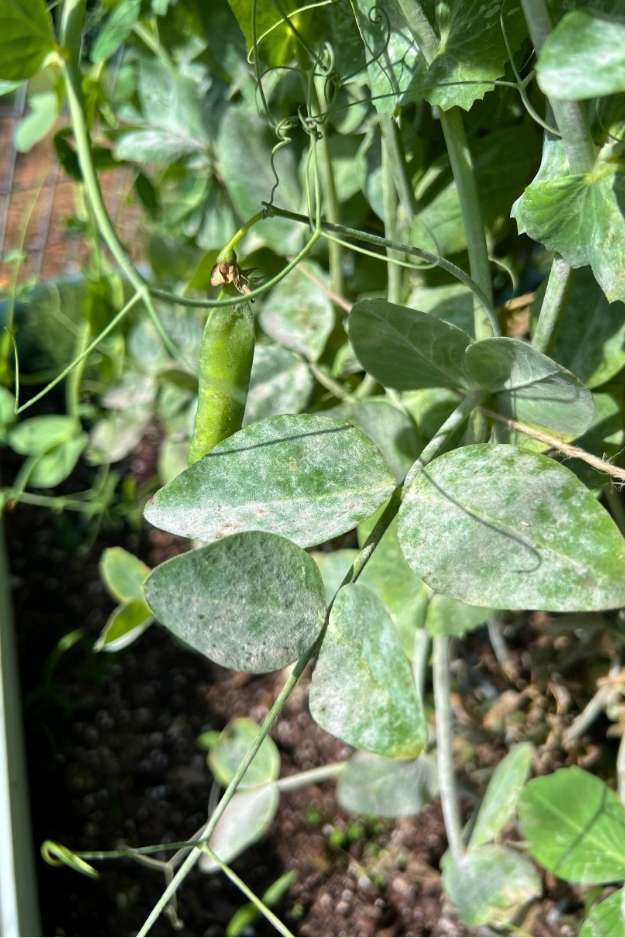
If you garden in Kentucky, you already know the look. That dusty, gray-white film that shows up on your squash leaves in the muggy part of summer like somebody walked through your garden flinging baking flour. It’s powdery mildew in Kentucky time! Last year it got my zucchini in the fall, this year it got my peas after the first humidity hit.
I’m not going to pretend I beat it overnight. But after losing plants to it, reading every conflicting thing on the internet, and finally sitting down with the University of Kentucky’s plant pathology research, I’ve got a system that works — and I figured out which of the popular “cures” were a waste of my money and my energy. Here’s the honest version.
First, the thing nobody tells you about powdery mildew in Kentucky
Powdery mildew is not like other fungal diseases, and this one fact changes everything about how you fight it.
Most garden fungus needs wet leaves to take hold — which is why we’re told to water at the base and keep foliage dry. Powdery mildew breaks that rule. It doesn’t need wet leaves at all. What it loves is high humidity around the plant, moderate temperatures, and shade — and if you’ve spent a Kentucky May-July out in the garden, you know we are handed all three on a silver platter. So when you look at a plant that got rained on for a week and think “the rain did this,” it’s not really the water on the leaves. It’s the muggy, still, crowded air around them.
That’s the reframe. We don’t have a rain problem. We have an airflow-and-humidity problem. And that’s actually good news, because airflow is something we can do something about.

The other thing worth knowing: powdery mildew rarely kills a plant outright. What it does is wear the plant down — fewer flowers, less fruit, weaker growth — and a stressed plant gets more vulnerable to everything else. So the goal isn’t really “kill the fungus.” It’s “keep the plant strong enough to keep producing.” That mindset shift took the panic out of it for me.
Would you like up to date Kentucky Homestead garden, pests, results, recipes?
I’ll send garden and Kentucky homestead knowledge as it happens and tips to help you over come it like I did. No Spam, I don’t have time for that either.
How to catch powdery mildew early in Kentucky (when you can still do something)
By the time the leaves look powder-coated, you’re playing defense. In Kentucky humidity this is a step worth taking.
Walk your susceptible plants — squash, pumpkins, cucumbers, melons, peas, and flowers like bee balm and zinnia — and look for:
- Talc-like white spots showing up first on the older leaves and on shaded parts of the plant, where the air is stillest
- Spots on both the top and underside of the leaves, so flip a few over when you scout — that’s where it likes to hide
- Spots that you can rub off with your finger (that’s how you tell it from other leaf issues, and from the natural silvery markings some squash varieties just have)
- Leaves that yellow, then go brown and crispy and die off — when a lot of leaves go at once, you get bare patches in the canopy
- In late season, tiny dark specks in the white patches — those are the structures the fungus uses to overwinter, which is your cue that next year’s problem is already setting up
An interesting thing I learned for cucurbit growers, because it surprised me: on squash, pumpkins, and cucumbers, the fungus doesn’t actually infect the fruit itself. The damage is indirect — it kills the leaves, and fewer working leaves means less photosynthesis, which means smaller harvests and lower-quality fruit. Lose enough leaf cover and your developing squash can even get sun scalded with no canopy to shade it. And it tends to hit hardest after the plant sets fruit and in crowded plantings — which is one more reason spacing matters so much. (Yup this is me, this was my biggest mistake on squash and peas)

Catch it at the first few spots and your odds are dramatically better than waiting until it’s everywhere.
The remedies, ranked honestly
This is the part everybody argues about. Here’s where I landed after the research, sorted by what’s actually worth your time.
What I do first — and it isn’t a spray. Prune out the worst-affected leaves and get them out of the garden (not in the compost). Then open the plant up: thin crowded foliage, make sure air can move through. Improving airflow does more than any bottle, and it’s free. I did this on my zucchini and it really helped when I planted them to densely.
Baking soda spray (the homemade one). A tablespoon of baking soda, a teaspoon of liquid soap, and a quart of water in a sprayer. It’s the recipe that floats around every Kentucky garden group for a reason — it’s cheap, it’s gentle on pollinators, and it genuinely helps. But understand what it is: it’s a preventative, best used early and reapplied, not a magic eraser for an established infection. Some folks use potassium bicarbonate instead of baking soda and find it a little kinder to plants over a long season. I am testing this and will report back.
Sulfur. This one actually works, and it’s been used for centuries — but only as a protectant applied before symptoms show up, not as a rescue. Two big cautions for us squash growers: sulfur can damage some squash and melon varieties, don’t spray it when it’s near or over 90°F, and don’t use it within two weeks of any oil spray. Read your label.
Neem oil. A reasonable organic option that some gardeners swear by, often applied to both the plant and the soil. Like the others, it works far better as prevention than cure.
Biological sprays (Bacillus subtilis). These are the “good bacteria fight the bad fungus” products. They’re pollinator-friendlier and worth a look if you want a low-toxicity route. (I am going to try this in the fall)
Copper fungicide. Here’s the one that surprised me, because it’s the answer everybody reaches for. According to the research, copper just isn’t very effective against powdery mildew specifically. And copper sprays can be hard on pollinators. So the thing half the internet recommends is, for this particular disease, near the bottom of my list. I use it to prevent on the fruit trees but still testing there and it nothing against the already established powdery mildew.
One rule that covers all the sprays: if a product can hurt pollinators, spray late in the evening when the bees have gone home, and only spray if you actually need to. We grow this food to be good for us — no sense poisoning the bees that make it possible.
And the hard truth about fungicides in general: they protect healthy tissue, they don’t cure infected tissue. Once a leaf is coated, spraying it won’t make it green again. That’s why prevention beats treatment every single time with this disease.
How I actually keep it from coming back
This is where the real win is, and it’s almost entirely about how you set the garden up — not what you spray on it.
- Give plants room. Crowding is the number one thing that creates the still, humid air powdery mildew wants. Space squash and cucumbers farther apart than feels necessary. This is my biggest mistake-I get to chaotic with my chaos gardening!
Trellising really helps here too! - Grow in full sun. Shade plus moderate temps is the fungus’s happy place. Sunny, breezy spots are not.
- Go easy on the nitrogen. Too much nitrogen pushes out lush, soft new growth — exactly the tender tissue powdery mildew infects most easily. Feed based on what the plant needs, not more.
- Plant resistant varieties. This is one of the most effective moves you can make, and it costs nothing extra at seed-buying time. Resistant or less-susceptible varieties exist for squash, pumpkins, cucumbers, melons, and peas — check the seed packet or catalog description. “Resistant” doesn’t mean immune, but it buys you weeks.
- Clean up hard in the fall. This is the one I learned the painful way, and it’s the answer to “I threw the plant away last year and it’s back.” The fungus overwinters in old infected debris. If you leave diseased leaves and stems in or near the bed, you’re planting next year’s outbreak. Pull it all and dispose of it — don’t compost it.
“Is it over? Can I still harvest?”
If your squash is mildewed and you’re wondering whether to give up — you probably don’t have to. Because powdery mildew rarely kills the plant outright and doesn’t infect the fruit directly, what’s already on the vine usually keeps developing, and anything that’s matured is fine to pick and eat. I just trimmed out the leaves on the squash and tried to thin the plants.
One thing to watch if you grow pumpkins or winter squash for storage: when the fungus weakens the stems and “handles,” those fruit don’t keep as long, so plan to use them sooner rather than stashing them away for months. If your plant is genuinely at the end of its run and covered, there’s no shame in harvesting what’s ready, pulling the plant, and cleaning up well so you start clean next spring. Sometimes the most productive move is to stop fighting a tired plant and protect next year instead.
The bottom line
I spent a season treating powdery mildew like a chemistry problem when it was really an airflow problem. The plants that struggle most in my beds are always the crowded ones in the stillest, most humid corners. Now I space wider, choose resistant varieties, keep a baking soda sprayer handy for early spots, skip the copper, and clean up like I mean it in the fall. It’s not gone — in Kentucky humidity, it never fully will be — but it’s manageable, and my squash keeps producing right through it.
That’s the real Kentucky answer: not one miracle spray, but a garden set up so the fungus never gets comfortable in the first place.
Sources I leaned on: University of Kentucky College of Agriculture, Food & Environment plant pathology publications (Powdery Mildew, PPFS-GEN-02; the Homeowner’s Guide to Fungicides, PPFS-GEN-07; and UK’s Veggie Scout guide to Powdery Mildew of Cucurbit Crops), plus home-garden guidance from University of California IPM, Penn State Extension, and Clemson Extension. As always — read and follow the label on any product, and when in doubt, your county Extension office will help you for free.
Leave a Reply