
Welcome to the Companion Planting Series for Kentucky Gardens
Companion planting can feel like trying to solve a puzzle — especially in Kentucky, where spring teases you for weeks, then sends a late frost, and summer humidity shows up uninvited. I’m not going to pretend I have it all figured out. I’m Erin, and this is Bloom & Peck Farm — a Zone 7 Kentucky homestead where I share what I’m learning as I go, including the wins, the fails, and the “well, that was interesting” moments in between.
This page is my growing hub for everything companion planting in Kentucky. I started this series 18 days post-spinal surgery in May 2025, trowel in one hand and a whole lot of hope in the other. I rely on books, YouTube gardeners I trust, and extension research to guide my experiments — and I’ll cite every one of them so you can dig deeper too.
Whether you’re gardening in raised beds, containers, or whatever patch of ground you’ve carved out — this is for you. 🌱

SECTION: WHY KENTUCKY IS DIFFERENT
Why Companion Planting in Kentucky Is Its Own Challenge
Kentucky isn’t just one climate — it’s a little bit of everything, sometimes in the same week. Most of us in central and eastern Kentucky are sitting in Zone 6b or 7a, which means:
- Last frost can hang around until mid-April, sometimes later in hollows and low spots
- Summer humidity is real and it brings fungal issues that gardeners in drier climates don’t think about as much
- Clay-heavy soil in many parts of the state means drainage is something you’re always working on
- Japanese beetles arrive like they own the place every June and July
- Tomato hornworm is not optional — it’s coming
These are the realities that make generic companion planting guides feel frustrating. So throughout this series I try to connect the advice to what’s actually happening in a Kentucky garden, in Kentucky timing, with Kentucky weather throwing curveballs. I lean heavily on resources like the Virginia Cooperative Extension’s companion planting guide and books like Carrots Love Tomatoes by Louise Riotte — but I also just try things and report back honestly.
Companion Planting as Healing Gardening
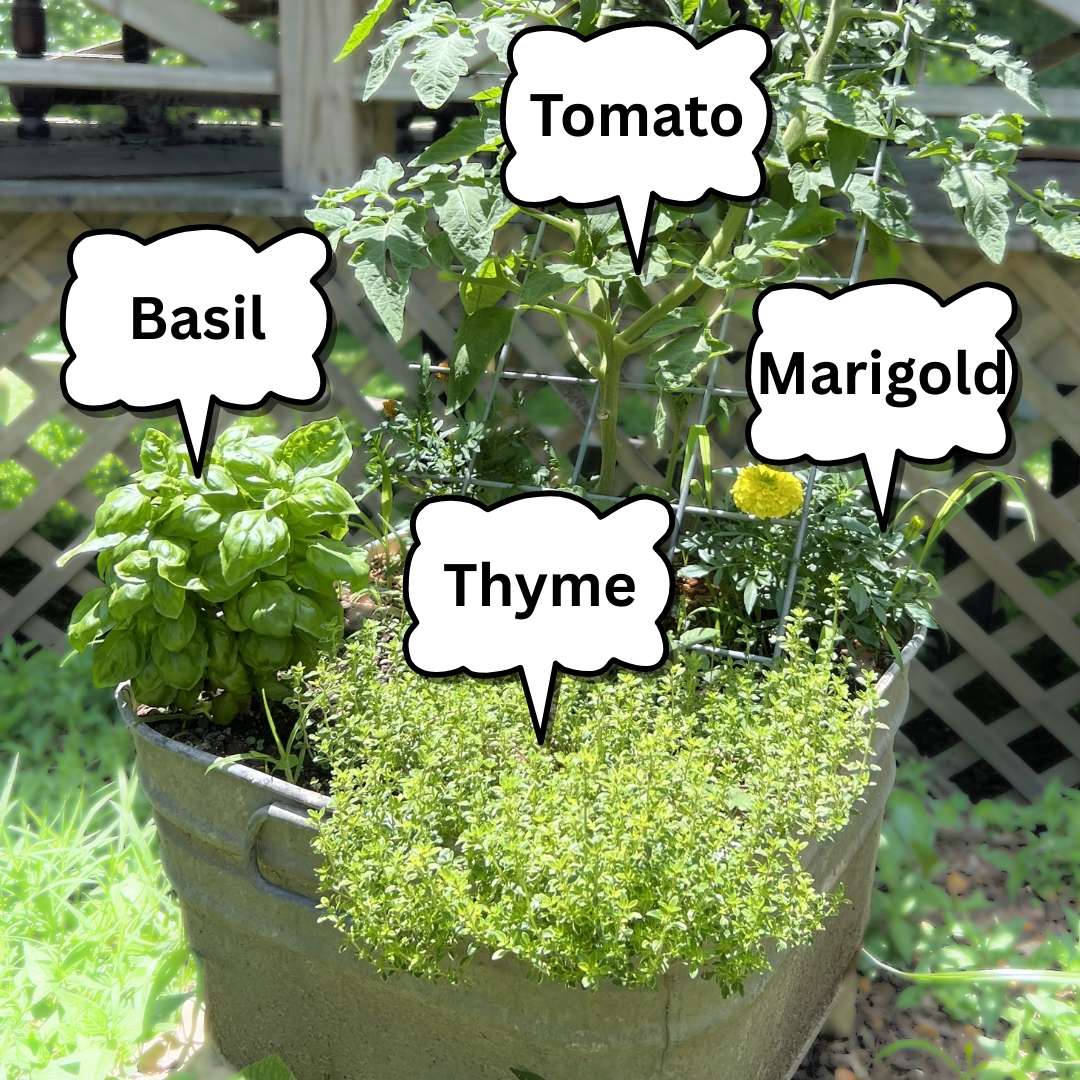
I launched this series 18 days after spinal surgery, planting basil at a waist-high table, trowel in hand, trying not to bend. That context matters because a lot of companion planting advice assumes you can move freely around a big in-ground garden. Mine started in a container on a DIY cattle panel trellis my son built for Mother’s Day — at chair height, so I could tend it without straining my back.
What I found is that container gardening is actually ideal for adaptive gardeners and small-space growers. When you can’t weed constantly or spread out across a big plot, having plants that naturally support each other — deterring pests, attracting pollinators, shading out weeds — means your garden can be doing more work even when you can’t.
If you’re gardening with limited mobility, recovering from something, or just working with a small space — the first 3 posts are especially for you. Raised beds are a big plus to this if you get the tall ones.

The Container Tomato Companion System I Use in Kentucky In a container you’re working with limited soil so every plant needs to earn its spot. Here’s how I layer companions in a single metal tub — basil up front for aphids, lemon thyme along the edges for whiteflies and hornworms, marigolds tucked at the base for nematodes. As seen in the picture above.
SECTION: COMPANION PLANTING GUIDES TABLE
Kentucky Companion Planting Guides — Tested in Zone 7
| Companion Plant | Best For | Kentucky Timing | What I Noticed | Read the Guide |
|---|---|---|---|---|
| 🌿 Basil | Tomatoes, aphid control | Plant after April 15 | Fewer hornworm eggs on my Cherokee Purple — could be coincidence, still doing it | Basil Guide → |
| 🌼 Marigolds | Nematodes, trap crop | Direct sow May | Planting again — they’re blooming and the bees love them | Marigold Guide → |
| 🌿 Lemon Thyme | Containers, whiteflies | Perennial, plant spring | Thriving in my metal tub container, nice living muclh | Thyme Guide → |
| 🌱 Chives | Soil health, general pests | Coming soon! | ||
| 🌸 Nasturtiums | Trap crop, aphids | Coming soon! |
EPIC GARDENING AFFILIATE
One thing that made starting this whole series easier was having quality seeds and supplies I could actually trust. I’ve been using Epic Gardening’s seed starting trays — they’re durable, made in the USA, and I’ve washed mine in the dishwasher between plantings without them falling apart (which, as someone trying to garden sustainably on a budget, matters). If you’re starting a companion planting experiment this season and don’t know where to begin with supplies, that’s genuinely where I’d send you.
Note: I’m an affiliate with Epic Gardening, which means I may earn a small commission if you purchase through my link — at no extra cost to you. I only share what I’m actually using in my own garden. Thanks for supporting this little homestead! 🐔

What’s Coming in the Companion Planting Series
This is a live, growing series — I’m adding to it as I plant, experiment, and observe. Here’s what’s on my list:
- 🌱 Chives — soil health and general pest support
- 🌸 Nasturtiums — the ultimate beginner trap crop
- 🌻 Zinnias — for pollinators and parasitic wasps that eat pest larvae
- 🫑 Pepper companions — I’m experimenting in my raised beds
- 🍓 Strawberry companions — coming with my food forest section
- A full Kentucky Vegetable planting calendar
Bookmark this page — it’ll grow alongside my garden.
Want to Stay Up to Date on Gardening in Kentucky?
Which companion plant are you excited to try? Share below! Follow this series for adaptive tips, sustainable gardening, and more. I may earn from affiliate links as my blog grows and I will update you along the way—thanks for supporting my homestead! 🌱🐔
Explore More From Bloom & Peck
This companion planting series connects to a few other ongoing experiments on the farm:
- 🍅 Tomato Trials: — where companion planting meets vertical growing
- 🫐 Raspberry Revival: Intercropping with Tulamagic — my experiment with intercropping in the fruit garden
- Growing Cucumbers in Kentucky
I’ve learned so much from these amazing resources:
- Carrots Love Tomatoes by Louise Riotte
- Good Neighbors: Companion Planting for Gardeners
- Epic Gardening, “Companion Planting” (https://youtu.be/mhr3REshTss?si=ccHOHuVnibcZb0e2)
- Virginia Cooperative Extension, “Companion Planting” (https://osustarkmg.org/wp-content/uploads/2020/06/Virgina-Coop-Extension-CompanionplantingRevised.pdf)
- No-Dig-VegetableGarden, “Intercropping and Polyculture” (https://www.no-dig-vegetablegarden.com/intercropping-polyculture.html)
- Roots and Refuge on YouTube (e.g., https://www.youtube.com/watch?v=TdI2YrNIf5g)
- Homesteading Family, “Designing a Food Forest” (https://homesteadingfamily.com/designing-a-food-forest/)