
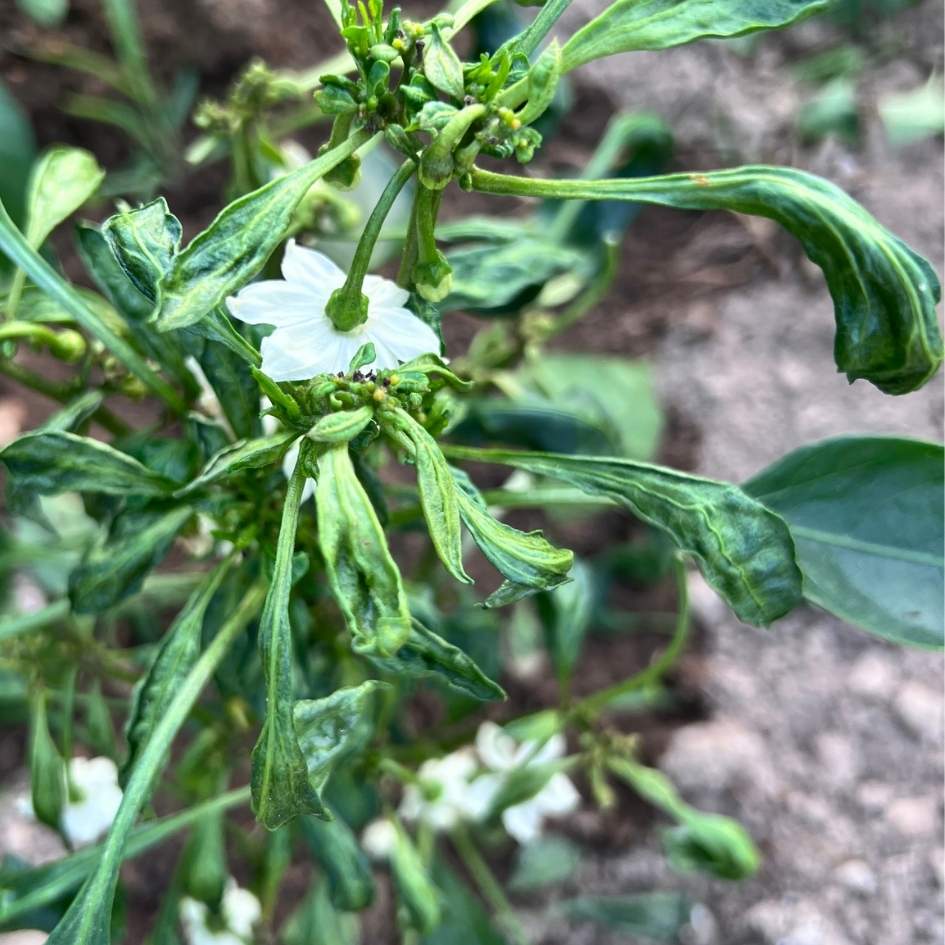
My search, what is wrong with my pepper plant? Then, why are my pepper plants leaves cupping? Nothing seemed to match what my peppers were doing. Most advice was I was over watering, or aphids. I had looked all over the leaves and could not see any bugs. My watering schedule was on point. They are in the high tunnel so no herbicide drift. Then I found a tip. Look closer.
What’s Wrong With My Pepper Plant Search.
If you are here you probably have been down this rabbit hole. Searching over pictures, putting images into google search. Nothing makes sense. The top curling leaves did not seem to match search images

The leaves weren’t discolored pointing to deficiency.
I even found an article from the UKY Extension on Pepper Plant Pests. I found another article that listed pests by month of infestation. The list of pests they gave me did not seem to match my search:
Insects
• Aphids
• Whiteflies
• Armyworms
• Colorado potato beetle
• Hornworms
• Leaf-footed bugs
• Stink bugs
• Thrips
It was so frustrating to not be able to figure this out. I should have reached out to my extension agent but I had already asked him questions on Non gmo feed that week and felt guilty for using so much of his time.
Then the tip that got me answers, look closer, A LOT closer.
Broad Mites On Pepper Plants
I got my jeweler’s loupe out and peered at the top leaves. BINGO.
Now, a word on magnification, because this is where I almost gave up. These mites are tiny — around 0.2mm — so a regular kitchen-drawer magnifying glass probably won’t cut it. You need real power to see them. Mine’s an old Tecnar Deluxe Hi-Power — a vintage folding loupe that’s actually my husband’s, confirmed at 10x. It’s one of those chrome ones with two glass lenses that fold together, so you can stack them for extra power, which is how I got in close enough to watch these things move.
A 10x jeweler’s loupe is about the minimum that reliably works — higher is even better if you want to see them clearly. And good light matters as much as the zoom, so get your plant in bright light or use a lit loupe. If you’ve been squinting through a basic magnifying glass and seeing nothing, that’s probably why — not because there’s no bug, but because you’re not zoomed in enough.
These mites are way smaller than aphids, which is exactly why they’re so hard to identify.
Here’s what’s actually happening to the plant: broad mites go after the newest, tenderest growth at the very top, and as they feed they inject a toxic saliva into that tissue. That’s what causes the twisting, cupping, and distorted new leaves — it’s the mites messing with the plant’s growth, not a nutrient deficiency like I first worried it might be. So if your top leaves are curling and warping but they’re not really discolored, that’s a big clue you’re dealing with something feeding on them, not something missing from the soil.Feeding damage details from Virginia Tech Extension.

After I finally identified them by Name not by leaf problem identification, I found where the UKY Extension talks about them. Broad mite (Polyphagotarsonemus latus).
Here’s the part that actually shaped how I’m treating them — their life cycle. Broad mites move fast: females lay somewhere around 30 to 75 eggs over a week or two, and those eggs hatch in just 2 to 3 days. The males actually carry the young females up to the fresh new growth to spread the infestation, and they can even hitch a ride on whiteflies to get around. So you’re not dealing with a slow-moving problem — the population turns over quick, which is exactly why timing your treatment to that cycle matters (more on that below). (Life cycle details from UF/IFAS Extension.)
What do Broad Mites look like On Pepper Plants?
Looking through the Jeweler’s loupe, I was able to film the little suckers crawling on the underside and stems of the pepper plant! See the white specks? If you watch the you tube video you can see them moving.
How to Identify The Broad Mite Pest Problem on Peppers

So how do you know it’s broad mites and not something else? The quickest tell is where the damage is and what you can see.
Broad mites hit the newest growth at the very top of the plant, curling and cupping the young leaves — and you basically can’t see the mites themselves with the naked eye. No webbing, no visible bugs, just twisted new growth up top while the older lower leaves look fine.
Spider mites are the ones most search results kept pointing me to, but they’re different: you can usually see them as tiny moving specks, they leave fine webbing and a stippled, speckled look on the leaves, and they tend to go after older leaves, not just the new growth.
So if your top leaves are warping and you can’t find a single bug or any webbing — that’s your sign to stop guessing and get the loupe out. Once you’ve ruled out the pests on the UK Extension list, grab at least a 10x jeweler’s loupe and look close at that new top growth for the little white dots.
And fair warning: don’t do the girly squeak like I did when I saw those little buggers moving! 🐛
How I Am Getting Rid of Broad Mites on Pepper Plants
The most common suggestion is a sulfur mix for your plants. Looking at the lifecycle of the mites, I am going to remove the leaves with clean snippers and put them in a plastic trash bag and toss them.
Next I am going to use the Captain Jacks Orchard Spray. The ingredients make sense to me for my garden and the pest problem. Sulfur (fungicide) and pyrethrins (derived from chrysanthemum plants — a natural insecticide). I will re apply every 7-10 days to coincide with the above mentioned pest life cycle.
Here are some real cautions to follow when using sulfur and pyrethrin. Sulfur can burn plants in high heat (roughly above 85–90°F) and shouldn’t be used close to any oil spray. And pyrethrins break down fast in sunlight, so evening application works better. My plan of attack is spraying in the evening so it has time to dry and not burn my plants.
So Far, the problem is gone
I am monitoring plants closely. One plant I did just remove because the damage was so overwhelming for the plant. I will update with photos as soon as the new leaves grow in.

Looking for more Growing Peppers In Kentucky Info? Follow this Link
Leave a Reply