
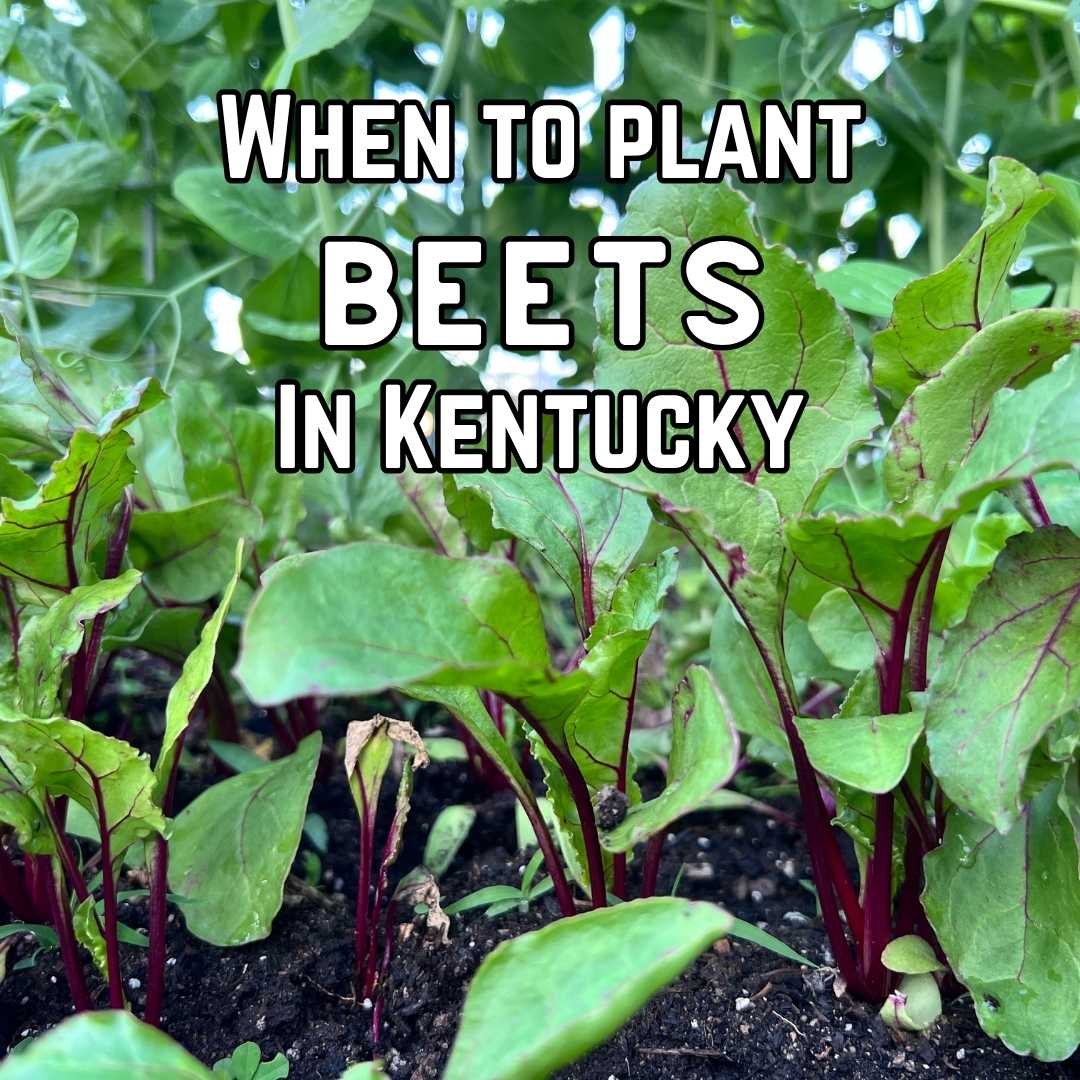
Last year I grew beets. They were pitiful.
If you are searching When to Plant Beets in Kentucky, here are some facts and my growing experience. I planted Detroit Dark Red in my raised bed, watched them come up, and then basically neglected them. Not enough water. Not enough fertilizer. The roots stayed small and sad and never became what they should have been.
The thing about beets is they’re supposed to be one of the easier crops. The UK Cooperative Extension describes them as easy to grow and quick to mature. So when mine failed, I had to be honest with myself about why — and it wasn’t the beets. It was me.
This year I’m back with Cylindra beets, a long cylindrical heirloom variety, I’m hoping will give me enough of a harvest to actually pickle. New raised bed, proper soil amendment, consistent watering, and radishes at the ends of my rows as germination markers.
SEE the Chart below For Spring and Fall Beet Planting Dates

Here’s everything I know about when to plant beets in Kentucky, what varieties work well in our climate, and how to not repeat my mistakes.
From my homestead: I garden in Zone 7a in western Kentucky. My beets are going into a new freshly amended raised bed this year — the same one my broccoli is going into. Better soil, better water, better attention. That’s the plan anyway.
When to Plant Beets in Kentucky
Beets are a cool-season crop that can be grown from early spring through late fall in Kentucky — they just don’t do well in the heat of summer. That gives us two excellent growing windows, and the UK Extension confirms that spring is the best season for beets in Kentucky.
They’re moderately cold tolerant, meaning they can handle light frosts, which makes them one of the earlier crops you can get in the ground each year.
| Western KY (Zone 7a/7b) | Central KY (Zone 7a) | Eastern KY (Zone 6b) | Notes | |
| 🌱 Spring Direct Sow — Earliest Safe Planting Date | 🌱 Spring Direct Sow — Earliest Safe Planting Date | 🌱 Spring Direct Sow — Earliest Safe Planting Date | 🌱 Spring Direct Sow — Earliest Safe Planting Date | 🌱 Spring Direct Sow — Earliest Safe Planting Date |
| Beets (direct sow) | Mid-March | Mid-March | Late March | Moderately cold tolerant |
| Radishes (row markers) | Early March | Early-Mid March | Mid March | Germinates in 3-5 days |
| 🍂 Fall Direct Sow | 🍂 Fall Direct Sow | 🍂 Fall Direct Sow | 🍂 Fall Direct Sow | 🍂 Fall Direct Sow |
| Beets (direct sow) | Jul – mid-Aug | Jul – mid-Aug | Jul – mid-Aug | Succession sow every 3-4 weeks See your frost dates beets need 50-60 days for maturity |
Source: University of Kentucky Cooperative Extension Service NEP-227 Growing Beets and ID-128 Table 20.14. Western/Central/Eastern regions based on UK Extension geographic breakdown. Zone cross-reference based on 2023 USDA Plant Hardiness Zone Map.
Tip: Not sure which region you’re in? Western Kentucky is roughly Zone 7a/7b, Central Kentucky is Zone 7a, Eastern Kentucky is Zone 6b. The Fayette County Cooperative Extension posted on March 11th reminding central Kentucky gardeners it was time to direct sow beets — that’s how real-time local these dates are.
When to Plant Beets Spring vs Fall in Kentucky
Grow both if you can. Spring beets mature before summer heat makes them tough. Fall beets develop in cooling temperatures which actually improves their flavor — the cold converts starches to sugars, making them sweeter.
- Spring — plant mid-March in western Kentucky, succession sow through April. Harvest before summer heat.
- Fall Garden — direct sow Mid July–August through early September depending on your region. Harvest October through November. Fall beets are often sweeter than spring beets.
From my homestead: My pickling goal is for the spring Cylindra harvest. If I get enough roots by June I’ll have my first batch of pickled beets. The fall crop will be for fresh eating and maybe a second pickling attempt.
Which Beet Varieties Grow Well in Kentucky?
There are more beet varieties than most beginners realize — and variety choice matters more than you’d think, especially if you have a specific goal like pickling or fresh eating.
Detroit Dark Red — reliable, forgiving, my starting point
This is what I grew last year and what I’m growing again this year. Detroit Dark Red is a classic deep red globe beet — smooth roots, sweet flavor, and widely available. The UK Extension lists it as a dependable Kentucky variety. When I failed last year it wasn’t the variety’s fault. It’s one of the most forgiving beets you can grow.
- Best for: fresh eating, roasting, general purpose
- Days to maturity: around 55-60 days
- Why I’m growing it again: because I want to prove I can do it right this time
Early Wonder Top — dual purpose
Also in my garden this year. Early Wonder is known for its exceptional greens as well as its roots — if you want to use both the tops and the roots, this is a great choice. The greens are tender and mild, good in salads or sautéed.
- Best for: greens AND roots — a true dual purpose beet
- Days to maturity: around 48 days — one of the faster varieties
- Good to know: harvest greens throughout the season — cut a few leaves at a time and the plant keeps growing

Cylindra — my pickling beet
This is the variety I’m most excited about this year. Cylindra is a long cylindrical beet rather than a round globe shape — it slices into uniform rounds which makes it ideal for pickling. Every jar looks consistent. If you want to put up pickled beets this summer, Cylindra is the variety to grow.
- Best for: pickling — uniform cylindrical shape slices into perfect rounds
- Days to maturity: around 55-60 days
- Heirloom: open pollinated, you can save seeds
From my homestead: My goal this year is to grow enough Cylindra to actually pickle a meaningful batch. I’ve never pickled beets before — this is the year. If it works, the recipe will be on the blog.
UPDATE Here is the fermenting post for cylindra beets.
Other UK Extension recommended varieties
- Red Cloud — dark red, sweet, smooth roots that can grow large
- Avalanche — white beet, mild and sweet, nice tall tops
- Chioggia — pink and white striped inside, beautiful for fresh eating and salads
- Touchstone Gold — golden beet, holds its color when cooked, milder flavor than red beets

Tip: If you want to try beets for the first time, start with Detroit Dark Red or Red Cloud — both are reliable, widely available, and forgiving for beginners.
How to Plant Beets in Kentucky
Direct sow — no transplanting needed
Beets are one of the easier crops because you direct sow them right in the garden where they’ll grow. No seed starting indoors, no transplanting. Push seeds about half an inch deep, 2 to 3 inches apart. Cover lightly with soil and keep the bed moist until germination.
Tip: Beet seeds are actually seed clusters — more than one plant may sprout from a single seed. Thin plants to 2 to 3 inches apart once they emerge so the roots have room to develop. This is where my beets went wrong the first year I grew them) — I didn’t thin properly and the roots competed for space. (it was a mess)
The radish row marker trick
Here’s something practical I’m doing this year that most beet guides don’t mention. Beet seeds are slow — they take 5 to 10 days to germinate, sometimes longer in cold soil. In the meantime you can lose track of exactly where your rows are, especially in a new bed.

I’m planting radishes at the ends of my beet rows as germination markers. Radishes sprout in 3 to 5 days — fast enough that they mark your row clearly before the beets even think about emerging. And then you get a radish harvest as a bonus while you wait.
From my homestead: This also works as a companion planting strategy — radishes help break up soil compaction near your beet rows which benefits the developing roots. Two problems solved with one packet of seeds.
I cover companion planting combinations in more detail in my Kentucky garden series — Kentucky Companion Planting Guide → bloomandpeck.com/kentucky-companion-planting/ One of my favorite companion plants for beets is Thyme. See more details Here.
Succession planting
Don’t plant all your beets at once. The UK Extension recommends sowing new rows every 3 to 4 weeks in spring to extend your harvest. By the time your first row is ready to pull, your second row is coming along. Your third row is just getting started. You get beets for weeks instead of all at once.
Tip: For pickling you actually want a big harvest all at once — so stagger your Cylindra less and let one row size up together. For fresh eating succession planting is perfect.
Soil and feeding — what I got wrong
This is the most important section for anyone who has grown beets and been disappointed. Beets are root vegetables — they develop underground. What you do above ground with water and fertilizer directly affects what happens below.
Last year I planted my Detroit Dark Red in a raised bed and then underwatered and underfed them. The roots stayed small. The soil in raised beds dries out faster than in-ground planting — it needs more consistent attention, not less.
- Water consistently — beets need steady moisture to develop. Don’t let the bed dry out completely between waterings. This is especially important in a raised bed.
- Amend your soil before planting — work compost into the bed. Beets need loose soil to develop properly. Compacted soil produces misshapen roots.
- Fertilize — a balanced fertilizer when plants are a few inches tall supports root development. I skipped this last year. I won’t skip it this year.
- pH — beets prefer slightly acidic to neutral soil, around 6.0 to 7.0. If you haven’t tested your soil recently your local UK Extension office can help.
Looking for More Vegetables?
Would you Like a Printable Vegetable Calendar?
YES, 30+ Veggies, In ONE printable 12 month by zone printable calendar. Written by a Zone 7a homesteader growing food to feed the family & sharing as I learn.
Plus occasional real-talk homesteading tips. No woo-woo, just what works.
Harvesting Beets
Beet roots are ready to harvest when they’re about 1.5 to 2 inches wide — about the size of a golf ball for round varieties. Pull them by grasping where the leaves meet the top of the root and pulling straight up.

Don’t wait too long. Beets left in the ground too long get tough and woody. Check them regularly once you’re past the days to maturity listed on your seed packet.
Don’t forget the greens
This is something a lot of beginner gardeners don’t realize — both the roots AND the leaves of beets are edible. The greens are nutritious and delicious, especially when small and tender at about 6 to 8 inches long.
Harvest greens by cutting a few leaves from each plant with scissors — don’t strip the whole plant. The UK Extension recommends harvesting only a few leaves at a time and waiting for more to grow back. Early Wonder is specifically worth growing for its exceptional greens.
Tip: Baby beet greens in a salad are genuinely delicious. Don’t throw them away while you’re waiting for the roots.
FAQ — When to Plant Beets in Kentucky
Mid-March is the sweet spot for most of Kentucky — beets are moderately cold tolerant and can handle light frosts. Western Kentucky can go a little earlier, eastern Kentucky should wait until late March. For fall planting, direct sow in August.
Yes — but raised beds need more consistent watering than in-ground growing because they dry out faster. This is exactly what went wrong with my beets last year. Amend your soil well, water consistently, and fertilize. Raised beds actually produce excellent beets when managed properly.
The most common reasons are inconsistent watering, insufficient fertilizer, not thinning seedlings properly, or compacted soil. Beets are root vegetables — what happens underground reflects exactly what you did or didn’t do above ground. Thin to 2 to 3 inches apart, water consistently, and feed with a balanced fertilizer once plants are a few inches tall.
In Kentucky you can plant beets twice — spring and fall. Spring planting starts in mid-March for most of the state. Fall planting starts in August. Avoid the heat of summer — beets don’t perform well when temperatures are consistently above 80°F.
Yes, Beet greens are nutritious and delicious, especially when young and tender at about 6 to 8 inches long. Use them raw in salads or sauté them like spinach. Early Wonder is a variety specifically worth growing for its exceptional greens as well as its roots.
Cylindra is my choice for pickling — its long cylindrical shape slices into uniform rounds which makes beautiful consistent pickle jars. For general purpose growing Detroit Dark Red and Red Cloud are both reliable Kentucky varieties.
Probably not for a full harvest — October is past the fall planting window for most of Kentucky. Beets need 50-60 days to mature, and need that time before a hard freeze locks in around mid-to-late October. If you’re in Western KY you might squeeze in a quick crop by sowing the first week of October for baby greens, but for root harvest, mid July-August is your real fall window. (See the fall planting table above.)
One beet seed cluster typically produces 2-4 seedlings once thinned, and each plant grows a single root. So if you sow a 10-foot row at 2-3 inch spacing, expect somewhere around 40-60 beets per row, depending on how well you thin and how consistently you water. I’m tracking my actual yield from this year’s Cylindra row — I’ll update this once I harvest.
The Pickle Jar Goal
I’ll be honest — beets have never been my favorite vegetable fresh. But pickled beets are something else entirely. Sweet, earthy, tangy, and beautiful in a jar. That’s the goal this year.
I’m growing Cylindra specifically because the shape makes perfect pickle slices. If this spring harvest goes the way I’m planning — with proper watering, proper feeding, and a new well-amended bed — I’ll have enough to put up my first batch.
When that happens the recipe will be right here on the Nourish side of Bloom & Peck. Because a homestead garden that feeds you through winter is the whole point.
Watch for it this fall! You can also get on the Bloom & Peck in the Know list below
Resources & Further Reading
- UK Cooperative Extension — Growing Beets Guide (NEP-227): publications.mgcafe.uky.edu/sites/publications.ca.uky.edu/files/NEP227.pdf
- UK Cooperative Extension — Home Vegetable Gardening in Kentucky (ID-128): publications.mgcafe.uky.edu/files/ID128.pdf
- Fayette County Cooperative Extension Horticulture — Planting Reminders for Central Kentucky
More From Bloom & Peck Farm
- When to Plant Peas in Kentucky → bloomandpeck.com/when-to-plant-peas-kentucky/
- When to Plant Broccoli in Kentucky → bloomandpeck.com/when-to-plant-broccoli-kentucky/
- When to Plant Cucumbers in Kentucky → bloomandpeck.com/how-to-grow-cucumbers-in-kentucky/
- Kentucky Companion Planting Guide → bloomandpeck.com/kentucky-companion-planting/
- Kentucky Gardening Hub → bloomandpeck.com/kentucky-gardening/
- Pickled Beets Recipe → bloomandpeck.com/nourish/ (coming soon — watch this space)
Leave a Reply