
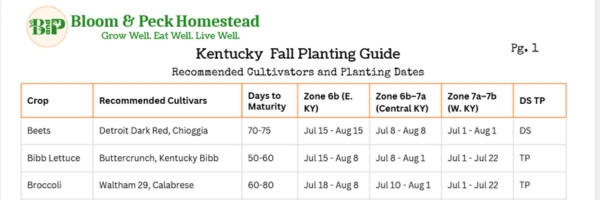
Every fall, I see new Kentucky gardeners ask: “is there a PDF Kentucky Fall Garden Planting Schedule?” I saw a need so I built This free Fall Kentucky vegetable planting schedule and calendar plus an Interactive calendar that answers that question—with 24 crops for zones 6b, 7a, and 7b across Western, Central, and Eastern Kentucky.
Why A Fall Kentucky Garden Planting Story…
I direct sowed some OLD Black Beauty zucchini seeds in my raised bed at the end of July, right before my grandson came to visit. He loves to help, so I found a little yellow watering can and garden rake. As soon as he arrived, he wanted to help — so I had him water the new zucchini hills. The next day, we spotted a tiny green sprout popping up. He beamed with pride. 💚 And every single day he wanted to check if it was going to be a “BIG BIG Flower.”
That moment reminded me how special fall gardening can be. And yes — there is still time to plant.
Quick Answer: When and What to Plant in Kentucky This Fall
If you landed here just needing dates — here you go. These are the key fall planting windows based on UK Cooperative Extension data, adjusted by zone.
Central KY (Zone 6b–7a — Louisville, Lexington, Frankfort):
- Cole crop transplants (broccoli, cabbage, cauliflower): July 10 – August 1
- Direct seed greens (lettuce, mustard, turnips, kale): July 8 – August 8
- Spinach: August 22 – September 8
- Radishes: September 1 – September 22
- First fall frost: October 15–20
Western KY (Zone 7a–7b — Paducah, Hopkinsville, Bowling Green): Plant roughly 1 week earlier than Central KY dates above. First fall frost: October 20–30
Eastern KY (Zone 6b — Pikeville, Hazard, Morehead): Plant roughly 1 week later than Central KY dates above. Fall arrives sooner — timing matters more here. First fall frost: October 5–15
👇 Keep reading for the full zone-by-zone planting schedule, what to plant in each month, and where to find transplants in Kentucky.
Some of the links below are affiliate links, which means I may earn a small commission if you purchase through them — at no extra cost to you. I only recommend products I use myself in my Kentucky fall garden, and I hope they’re helpful to you too as you get started this August.
The Fall Garden: Most Kentucky Gardeners Don’t Use This Window
🍁 By July, a lot of gardeners are mentally done with the season. Just managing what they have, looking forward to fall. I was exactly that person last year after stress from family health and surgery issues — there’s only so much you can do. I missed the whole fall window and I’m not beating myself up about it.
But this year I’m ready.
Here’s the thing: July and August are prime time for starting your fall garden, and it’s the most underused window in Kentucky gardening.
🥕 Broccoli, cabbage, kale, carrots, beets, turnips, and spinach all have a fall window here. UK Cooperative Extension specifically notes that fall broccoli quality is often superior in Kentucky because it matures in cooler air. You’re not squeezing out a desperate second planting — you’re using a genuinely excellent growing window that most people skip entirely.
A note for Eastern KY gardeners: your window is shorter because fall arrives earlier. Timing matters more in the mountains. In Western KY you have a little more wiggle room. Either way — don’t sleep on it.
PSSST — I’m putting in a hobby-size high tunnel this year. Post is coming!
Your Kentucky Zone — Corrected for 2023
August is prime time for transplanting Cole Crops and direct sowing seeds. Last year, I picked up some cole crop transplants at a local garden center. You can also direct sow seeds throughout August, depending on your frost dates.
Kentucky is often described as “Zone 6 and 7” and that’s true — but the specific subzones matter when you’re counting back from first frost.
Here’s the accurate breakdown per the 2023 USDA Plant Hardiness Zone Map and UK Extension ID-128, Figure 20.8:
| Zone | Region | Last Spring Frost | First Fall Frost | Growing Season |
|---|---|---|---|---|
| Zone 7a–7b | Western KY (Paducah, Hopkinsville) | Apr 20–30 | Oct 20–30 | 160–175 days |
| Zone 6b–7a | Central KY (Louisville, Lexington, Frankfort) | Apr 30–May 5 | Oct 15–20 | 150–160 days |
| Zone 6b | Eastern KY (Pikeville, Hazard, Morehead) | May 5–10 | Oct 5–15 | 145–150 days |
One important note: Cool nights slow everything down in fall. The days-to-maturity on your seed packet assumes summer growing conditions. Add 10–14 days to any maturity date for fall plantings. Count backwards from your first expected frost to find your latest safe sow date.
Want to track your specific microclimate? WeatherSpark has a great Kentucky October comparison tool that lets you compare actual historical frost data by city. Your own garden journal beats any chart — but this is a great starting point.
Beginner Tip: Plant only what you want to process and eat.

Sample of Average Frost Date
Research for Kentucky Fall Gardens
From WeatherSpark.com
Free Printable: Kentucky Fall Planting Guide
July and August are the most underused gardening window in Kentucky. I put together a printable planting guide with 24 crops, zone-specific dates, cultivar picks, and tips so you don’t have to guess. Enter your email and I’ll send it straight to your inbox.
Kentucky Fall Garden Planting Schedule by Zone
All dates from UK Cooperative Extension ID-128, Tables 20.13 and 20.14. Central KY is the baseline — Western plants ~1 week earlier, Eastern ~1 week later.
Cole Crops — Start Transplants First
These need to go in earliest because they take 60–80 days to mature. Start seeds indoors or buy transplants.
| Crop | Central KY | Western KY | Eastern KY | Harvest |
|---|---|---|---|---|
| Cabbage | Jul 1 – Jul 22 | Jun 22 – Jul 15 | Jul 8 – Jul 29 | Sep–Nov |
| Broccoli | Jul 10 – Aug 1 | Jul 1 – Jul 22 | Jul 18 – Aug 8 | Sep–Nov |
| Cauliflower | Jul 10 – Jul 22 | Jul 1 – Jul 15 | Jul 18 – Jul 29 | Sep–Nov |
Fall broccoli often tastes better than spring broccoli in Kentucky — it matures in cooler air and the flavor is sweeter. UK Extension confirms this. Worth the effort.
Greens — Direct Seed, Succession Plant
| Crop | Central KY | Western KY | Eastern KY | Harvest |
|---|---|---|---|---|
| Leaf Lettuce | Jul 8 – Sep 1 | Jul 1 – Aug 22 | Jul 15 – Sep 8 | Sep–Oct |
| Mustard Greens | Jul 8 – Sep 1 | Jul 1 – Aug 22 | Jul 15 – Sep 8 | Sep–Oct |
Lettuce is your friend here — sow a short row every two weeks and you’ll have fresh salad greens well into October.
Root Vegetables — Direct Seed
| Crop | Central KY | Western KY | Eastern KY | Harvest |
|---|---|---|---|---|
| Beets | Jul 8 – Aug 8 | Jul 1 – Aug 1 | Jul 15 – Aug 15 | Oct |
| Radishes | Sep 1 – Sep 22 | Aug 22 – Sep 15 | Sep 8 – Sep 29 | Oct |
Carrots and beets get sweeter after a frost. If you can wait, they’re worth it.
Legumes
| Crop | Central KY | Western KY | Eastern KY | Harvest |
|---|---|---|---|---|
| Snow Peas | Aug 1 – Aug 8 | Jul 22 – Aug 1 | Aug 8 – Aug 15 | Oct |
Snow peas need to be planted right on time and will need irrigation — August is dry in Kentucky.
Want more crops? There are 24 in the Free Kentucky Kentucky Fall Garden Planting Schedule
Interactive Kentucky Fall Garden Planting Schedule
👇 Toggle between Western, Central, and Eastern KY to see planting dates for your zone — or scroll down for the free printable PDF.
Click a zone to adjust all the timing at once. Color coding: light green = direct seed outdoors, dark green = transplant or peak planting, tan = start indoors, blue = fall planting, yellow = harvest window.
| Crop | Sow / Plant | Method | Days to Maturity¹ | Harvest Window |
|---|
¹ Cool temperatures slow maturity in fall — allow extra time. Dates from UK Extension ID-128, Table 20.13 & 20.14.
| Crop | Jun | Jul | Aug | Sep | Oct | Nov |
|---|
Western KY plants roughly 1 week earlier than Central · Eastern KY plants roughly 1 week later and fall arrives sooner — timing matters more in Zone 6b.
Key tip: Fall crops take longer to mature than the seed packet says. Cool nights slow growth. Count backwards from your first expected frost to set your latest safe sow date.
Source: UK Cooperative Extension ID-128, Tables 20.13 & 20.14 · 2023 USDA Plant Hardiness Zone Map · Guide by Bloom & Peck
Want the full breakdown by month? I have dedicated guides for each:
→ What to Plant in April in Kentucky
→ What to Plant in May in Kentucky
→ What to Plant in June in Kentucky
Coming soon
→ What to Plant in July in Kentucky
→ What to Plant in August in Kentucky
→ What to Plant in September in Kentucky
🛒 Where to Get Fall Seeds & Starts for the Fall Kentucky Garden
This is honestly one of the harder parts of fall gardening in Kentucky. Big box stores are the obvious option but local is better when you can find it.
Local Garden Centers (Kentucky — I’m Still Scouting)
Anna’s Garden — Russell Springs · +1 270-866-4669 · Facebook (I’m getting my cole crops here this year. Mid-August availability confirmed 8/11/2025)
Alexandria Garden Center — Alexandria · (859) 635-5555
Wallitsch Garden Center — Louisville · (502) 454-3553
I am actively calling, emailing, and messaging local centers. I’ll keep updating this list. Get on my email list for Fresh Finds Fridays updates.
Check the Kentucky Department of Agriculture farmers market directory — some vendors carry transplants in late summer.
Online Transplant Sources
- Burpee — seed packets have a plant bundle option
- Harris Seeds — live plants
- Organic Harvest Homestead — live plants
- Grow Joy — live plants from their own greenhouses
My Favorite Seed Suppliers for Kentucky
Seed hoarding is absolutely a thing. I can confirm that germination drops dramatically with old seeds. I try to stick with suppliers that fit our climate — heirloom, non-GMO, and not Monsanto.
- Southern Exposure Seed Exchange — tailored for the South, found them while researching this post and I’m a fan
- Botanical Interests / Epic Gardening (affiliate) — small space seed bundles are great
- Seed Savers Exchange
- Johnny’s Selected Seeds — their fall planting date calculator is a must-use

🌱 If I don’t have time to plant for my Kentucky, then I will try to find them at local nurseries. That can be problematic as some nurseries or garden centers only carry flowers. So online is the next option.
🌱 Seed Starting Tips for Fall Garden
- Start brassicas indoors now using Epic seed trays (affiliate link) to stay cool and avoid pests.

- Place seed trays in part shade to avoid heat stress—basements with grow lights work well (mine stays at about 72 degrees, fingers crossed).
Therefore, things like peas can be started in the refrigerator! I saw this tip online, and I will link it when I can find it again. Honestly, I am not sure I’d want dirt in the fridge. - Harden off seedlings for 4–7 days before transplanting outside.
- Direct sow root crops and greens directly into moist, well-worked soil. Water daily until germination.
- Use shade cloth (30–40%) for transplants in the August sun.
Real Notes From a Columbia, KY Zone 7 Garden
Microclimate beats zone every time. A raised bed in full sun against a south-facing fence runs weeks ahead of an in-ground plot with afternoon shade. Know your specific conditions, not just your zone number.
Soil temperature matters more than air temperature. In late summer, the soil stays warm even as nights cool. That’s actually good for germination — but it means your transplants need shade cloth until they establish.
Late frosts happen in spring, early frosts happen in fall. I’ve had frost in the first week of October in Columbia. Keep an eye on the forecast from late September on and have a row cover ready. The calendar gives you averages. Nature gives you surprises.
Keep a garden journal. I’m not a journal person either — but I do buy a spiral-bound calendar every year and write planting dates, weather events, and what worked. Your own notes from your own yard beat any guide, including this one.
Sources
All planting dates in this post are based on:
- UK Cooperative Extension ID-128, Home Vegetable Gardening in Kentucky, Tables 20.13 and 20.14
- 2023 USDA Plant Hardiness Zone Map
- UK Extension ID-128, Figure 20.8 for frost dates
Dates are approximate. Always check your local forecast and adjust for your specific microclimate. Contact your county Extension office for local guidance.
University of Kentucky Cooperative Extension Publications 2023 USDA Plant Hardiness Zone Map
Guide by Bloom & Peck · Grow Well. Eat Well. Live Well.
Leave a Reply