
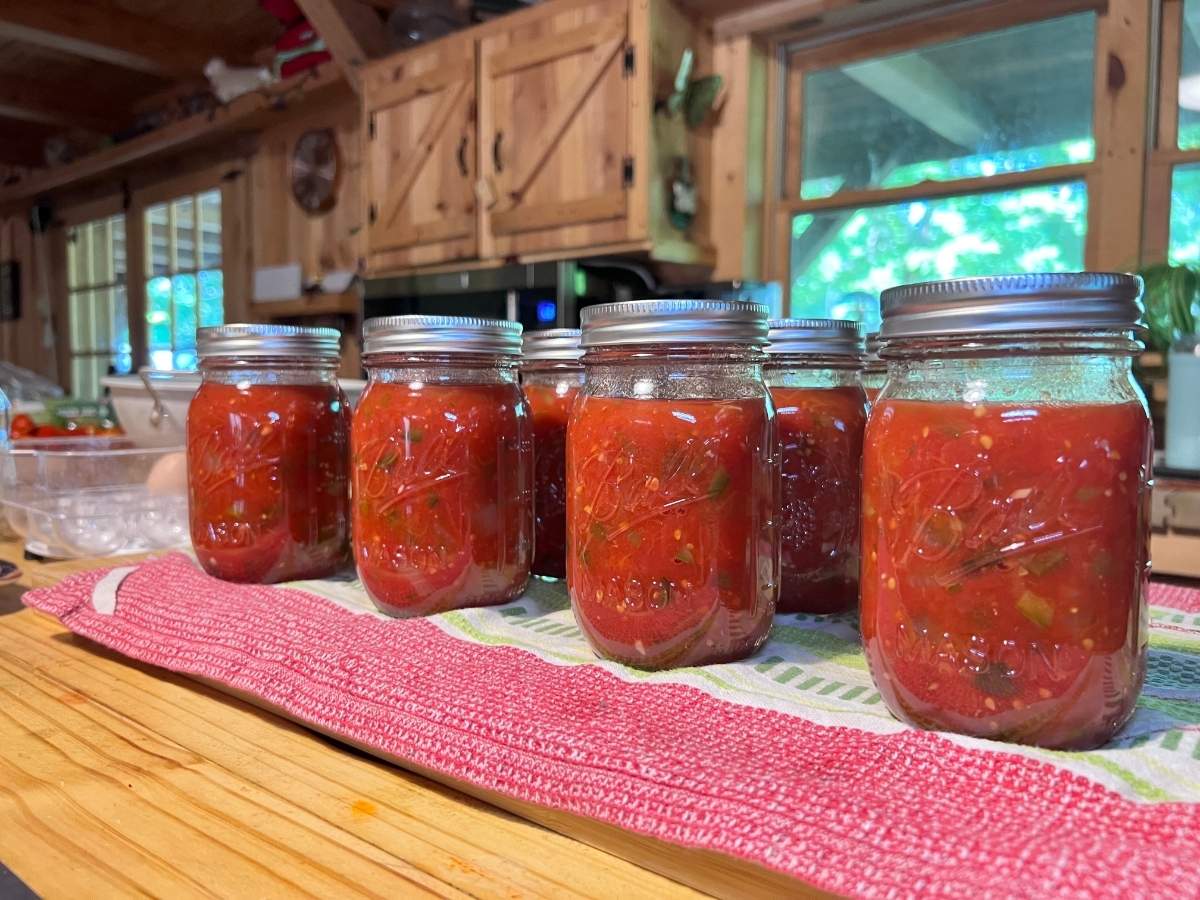
When I grow San Marzano tomatoes, I think of marinara sauce. The fantastic result I discovered is canning salsa with my garden-fresh San Marzano tomatoes, not canned.
I knew this recipe was a keeper when my 31-year-old son stopped by for a Taco Tuesday family meal. I had just opened a jar of my newly canned Garden Fresh San Marzano Salsa when he came up with a chip. After his first dip, I waited for his reaction. He didn’t have one- deadpan expression. He slowly picked up the jar, held it to him, and said, “My Precious!” and ran for the door! I guess it passed the test!
This is one of a few reasons I will grow San Marzanos over another paste tomato; I wrote more about that in my post San Marzano vs Roma. These are my real experiences and my whys when it’s the two of us or for a larger family.
Why I Use Garden Fresh San Marzano Tomatoes, Not Canned
Currently, I am about growing or finding things as fresh from the garden as possible. I wanted a salsa where I could control the additives, type, and amount of salt. So, like other recipes that started with, “Add Canned San Marzano to your pot,” I wanted one that started with fresh. Since they are a paste tomato, they are perfect for salsa.
When you start really looking at tomatoes, paste tomatoes have a fantastic structure. They have thicker walls, which give a little more meat to the recipe. The San Marzano tomato has less juice than a beefsteak tomato, so your recipe isn’t super watery when using a paste variety. I do grow a few different types of tomatoes, and you can see that here in my Best Tomatoes for Kentucky post.
The paste tomato recipe I found is a tested recipe from the National Center for Home Food Preservation. The star of this is adding the garden-fresh San Marzano and making all the measurements work for the correct acid ratio when I couldn’t have 28 cups ready at once. As a new canner, I did not want to make a mistake and ruin a lot of work. And I am here to say, peeling tomatoes is a lot of work.
Insight: If you are ever gifted a jar of salsa that someone peeled the skins off, believe me, their feet hurt at some point and they really, really like you.
Why Use a Tested Recipe?
As a new canner, I want to make sure I am doing things right to keep us healthy. In this day and age, not a lot of botulism happens, but it does happen. With my luck, it will happen to me. So I go for the tested recipe. The right amount of tomatoes, peppers, acid, and onions matters in the canned food environment.
I liked this recipe because I could use lemon juice or lime juice, which gives it a “brighter” flavor. The guidelines say don’t interchange it with vinegar; there are other recipes for that. At some point, I’d like to see the side-by-side comparison for the “safe amounts” of acid.
Insight: According to the NCHFP, you can change the hot pepper type (I used jalapeño, bell, and poblano) but not the weight.
What You Will Need to Water Bath Can Garden Fresh San Marzano Salsa
Ingredients:
I did not weigh because I peeled, cored, and chopped 22 cups of San Marzano Tomatoes. The original recipe called for 28 cups; (link is at the end of this post) I did keep the ratios correct so I did not deter from the original quantity. I also did not choose to add the optional spices to mine. The San Marzano and other garden fresh onions and peppers are just that good.
| Ingredients for Mild Salsa | Made 12 Pints |
| San Marzano Paste Tomatoes | 22 cups |
| Pablano & Bell Peppers | 3 1/4 cups |
| Jalapeños | 1/4 cup |
| Onion | 3 3/4 cups plus 2 tbs |
| Garlic | about 5 cloves |
| Bottled lemon/lime juice | 1⅝ cups |
| Salt | 1½ Tbsp |
| Black pepper | 2⅓ tsp |
| Cumin | 1½ Tbsp, optional |
| Oregano | 2 Tbsp, optional |
| Cilantro | 1½ Tbsp, optional |
Equipment
12 Pint Jars
Lids
Water bath canner
Canning supplies
Stock Pot
Pairing Knife
Cutting Board
STEP 1 — GROW & PICK
Growing San Marzano or any other tomato in Kentucky a relatively easy task. With plastic high tunnels, you can control watering if you are that crazy about it, IE like me! I choose to grow the San Marzano (link) over other paste tomatoes for the flavor. You can pick these and keep them in the fridge for a few days while you gather enough to can. Alternatively, check local farmers’ markets and support your local grower.

I also grew my own onions, peppers, and garlic, so this is truly a garden-fresh salsa.
STEP 2 — PEEL
This was what truly had me worried. The peeling and blanching. I had never done this before with tomatoes, and it was a bit scary. I score and core my freezer tomatoes, so I was ready for that part.


After blanching they go into the ice bath and then peel the skins.
The peeling truly took the most amount of time. See the video below.
Final step for the tomatoes is coring and chopping.

You can also blister and peel the pepper skins, but I passed on this, and it did not come out tough.
STEP 3 — MAKE THE SALSA
Now that I had my tomatoes ready, the rest came together quite quickly. Chop up the other veggies to about a 1/4″ onions, peppers (wear thick rubber gloves here and DON’T touch any of your skin), and garlic and cook them for the hot pack. I followed the amounts and instructions from the NCHFP. For me, I left out the optional spices, as I wanted to have the taste of all my veggies. You can add them to suit your taste.

Cook the salsa down. Combine all ingredients with the exception of cumin, oregano, and cilantro in a large saucepot and apply heat (my stove worked best on 4) while stirring frequently until the mixture reaches a boiling point. Lower the heat setting and allow the mixture to simmer for 10 minutes, stirring at intervals. Incorporate the spices and continue simmering for an additional 20 minutes, stirring at intervals. Get ready to ladle the cooked salsa into jars.

STEP 4 — Canning Garden Fresh San Marzano Salsa
I have a few canning tools: my water bath canner (I found at a garage sale) and my Ball Utensil Set. Have these things ready while your salsa is cooking.
- Make sure your jars and lids are sterilized according to their manufacturer’s instructions. And keep them warm.
- Preheat the water: Heat the water in your canner to a simmer; this prevents the jars from cracking with quick temp change. (You can see in the picture above that my Water Bath canner is simmering while the salsa is cooking)
- Fill the jars with the hot salsa, filling to 1/2” headspace; wipe the rims with a damp clean cloth (if its ok for your lids, use a bit of vinegar), making sure they are clean. And add the lids (Make them hand-tight).
- Submerge the jars: Use a jar lifter to carefully place your filled, sealed jars onto the rack inside the canner.
- Cover with water: Ensure the water level sits 1 to 2 inches above the tops of the jars, adding more hot water if needed.
- Put the lid on the canner, turn the heat up to high, and bring the water to a full rolling boil. Only start your processing timer once the water reaches a rolling boil.
I am at 900 ft altitude, so I start my timer to go off at 15min.
Times are set to altitude like this:
Hot Pack: Pint Jars
0-1,000 ft elevation 15 Min
1,001-6,000 ft elevation 20 Min
6,000 ft and above 25 Min.
Cool 12–24 hrs, check seals, label, and take those lids off before storing.

RECIPE CARD (WP Recipe block)
YIELD, STORAGE & THE JAR-SHELF TIE-IN
The amount I got above gave me 12 pint jars of My Precious Delicious Garden Fresh San Marzano Salsa. There are just two of us, so I don’t necessarily need 24 jars. Honestly, I’d eat it every day, but hubs does not agree with my taco kind of life. According to https://www.canr.msu.edu/news/preserving_safe_salsa (accessed sept 17, 2026), jars of salsa can be stored 12 to 18 months. Mine won’t last that long, though. I kind of wish now that I had done 24 jars! Remember to remove the rings (I put mine on a wire coat hanger) so you can see if something happens to the seal. Store in a cool, dark, dry space. I put mine in the basement pantry we built.
Serving your Garden Fresh San Marzano Salsa
If my name was Frank, I’d put that _H$t on everything. I do put it on my scrambled eggs, dips for chips, of course, tacos, and anything else I want to spice up a bit.
I like this recipe as I can safely adjust the amount of peppers to make it hotter or milder. Per the recipe, I Do Not alter the proportions of vegetables, but I can adjust which peppers to use per NDSU.https://www.ndsu.edu/agriculture/extension/publications/food-preservation-lets-preserve-salsa
Original tested recipe is from https://nchfp.uga.edu/how/can/canning-salsa/tomato-salsa-with-paste-tomatoes/
FAQ
Can I use Roma or regular tomatoes?
This particular recipe is for paste-type tomatoes. So a regular tomato would not work here. There are other tested recipes such as Choice Salsa, that you can use regular tomatoes Per the “canning” guidelines.
Do I have to peel the tomatoes?
I think for this recipe you have to peel them. You aren’t using an immersion blender to make a restaurant-style salsa. So you’d get bits of tough skin in your salsa.
Can I make it hotter/milder?
Oh Yes! Adjust to your desired heat by adjusting the types of peppers you use. Just don’t change the quantity or it will mess up the acidity levels.
How long does canned salsa keep?
I honestly haven’t had it last more then 12 months. But the recommendation is 12 -18 months.
Why bottled lemon juice instead of fresh?
Bottled lemon juice has a set acidity level in its recipe, whereas fresh lemon juice isn’t consistent. And you need the 5% acidity level to make the salsa shelf-stable. Use it in fresh salsa, though!
Enjoy Your Fresh San Marzano Salsa
As my son still tries to steal jars of “his precious” I have him on tomato peeling duty if he wants to earn a jar lol. He might get a jar in his stocking, if it lasts that long. He doesn’t know it yet but I am making him 12 jars of Marinara for Christmas, as he loves to make a protein-packed spaghetti for his meal prep.
Leave a Reply