
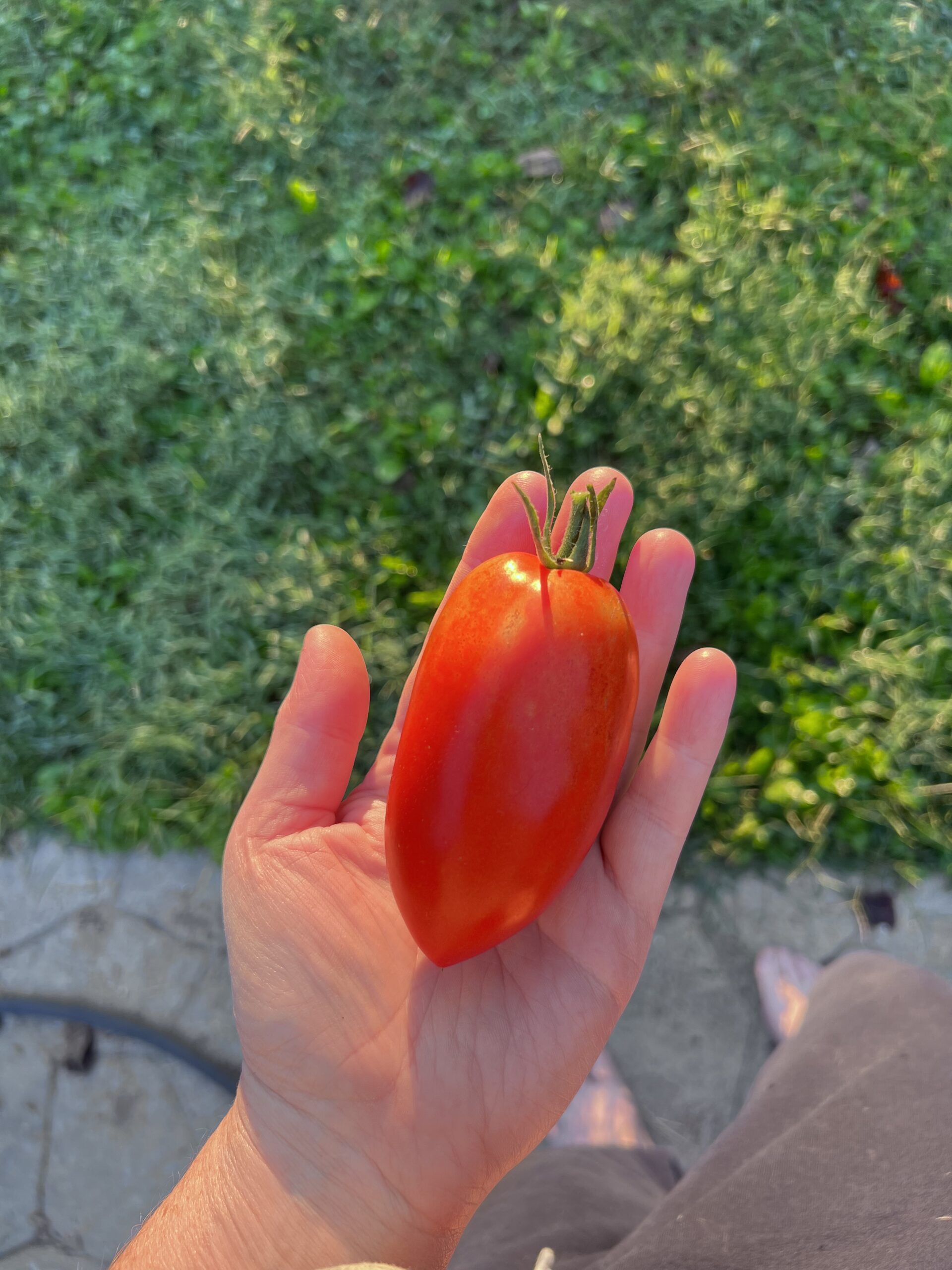
There’s a bowl of tomatoes sitting on my kitchen scale right now, and it’s maybe five pounds (the the ones on the side) — a few days’ worth of picking, not some big once-a-summer haul. This is where San Marzano vs Roma in a small garden matters.

The internet is pretty sure about this one, grow Roma. Nearly every guide out there tells you to grow a Roma for a small garden — compact plant, ripens its whole crop at once so you can can a big batch in a weekend. I’m going to tell you why I skip the Roma and grow San Marzano instead. And honestly? For a lot of people that Roma advice is perfectly fine. It just isn’t right for us.
But there are two of us. The last thing I want in August is thirty pounds of tomatoes all screaming to be dealt with on the same Saturday. What I want is a handful every few days — enough for tonight’s dinner, with a little extra now and then to put up. So I went the other direction, and I’ve never looked back.
Here’s why I grow San Marzano instead, and everything I’ve learned keeping two people in sauce tomatoes without drowning in them.
This post contains affiliate links with seeds and items I actually use, if you partake in one of these links there is no extra cost to you, thanks for your support.
San Marzano vs. Roma for a Small Garden — Why I Went the Other Way
First, let me clear up the thing that confused me for the longest time, because I think it’s the reason nobody can seem to agree on this tomato.
There isn’t just one San Marzano. There are two different plants sold under that same name. One is a shorter, bushy determinate that tops out around four or five feet and gives you most of its fruit in one flush. The other is a tall, climbing indeterminate that runs six feet or more and keeps setting fruit right up until frost. Same name on the packet. Completely different plant in your garden.
That’s why one website tells you San Marzano is a compact determinate and the next one swears it’s a towering vine — they’re both right, they’re just describing different seed lines. And it matters a lot, because a four-foot bush and a six-foot vine need completely different support and give you completely different harvests.
Here’s the tip that would’ve saved me a season of guessing: look for the word “pole.” or Indeterminate. When a seed company calls it a “pole” tomato, that’s the old-fashioned word for indeterminate — a climbing vine. The one I grow is listed as a San Marzano Roma Pole Tomato, right there on the packet as indeterminate, vines to six feet and up. If it doesn’t say pole and it says determinate, you’ve got the short bushy one. Read the packet before you buy, not just the name.

I did grow Roma tomatoes for a few years, and they were nice when I wanted the big batch all at once. I planted them in a raised bed and grew them up a string to an overhead DIY messy trellis. You can see the green Roma tomatoes on the plants in this picture.

Here’s how the three stack up:
| Trait | San Marzano “Pole” Indeterminate — what I grow I grow this | San Marzano Roma Determinate line | Roma Classic determinate |
|---|---|---|---|
| Growth habit | Indeterminate — produces till frost | Determinate / semi-determinate — main flush, then keeps going in a long season | Determinate — one main flush |
| Height | Vines 6 ft+ (mine still climbing in late August) | ~4–5 ft | 3–4 ft |
| Support | Tall trellis (I run t-posts in my high tunnel) | Trellis or stakes | Minimal — a cage or short stake |
| Harvest rhythm | Steady trickle over months | Main flush, then a trickle in a long season | Most fruit ripens together |
| Days to maturity | ~70–90 days | ~70–79 days | ~75 days |
| Fruit | 3–4 in, pointed, sweeter, less acidic | Same meaty, low-juice San Marzano fruit | Blockier, meaty, milder |
| Best for two? | Yes — pick as you need, all season | Also great; smaller footprint | Better for one big canning day |
Highlighted column is the variety I grow. Days to maturity and heights are typical ranges and will vary with climate, soil, and season length.
Now here’s the part the “grow a Roma” crowd misses. They treat “ripens all at once” like it’s the selling point. And if you’re feeding a big family or filling a pantry, it is. But when it’s just two of you, a plant that dumps its whole crop in one week isn’t a convenience — it’s a chore with a deadline. The indeterminate San Marzano hands me a little at a time, for months. That slow trickle everyone lists as a downside is the exact reason I grow it

🍅 Grow Your Best Tomatoes— Get the Kentucky Tomato Guide
The Fruit Is the Whole Point
I’ll be honest — I put up with a fussier plant just for how these taste. San Marzano are meatier and sweeter than a standard Roma, with less of that tinny acidity, and hardly any juice or seeds to cook off. When Italians say this is the sauce tomato, they’re not being dramatic. A pot of these cooks down into something you’ll want to eat with a spoon.
And because they come in a few at a time, I get to actually use them — a handful roasted for dinner here, a couple sliced onto a sandwich there — instead of standing at the counter all day just trying to keep up. The rhythm fits how two people really cook.
The one catch is that all that vigor has to go somewhere, and with the pole type, it goes up. So let’s talk about holding six feet of tomato vine off the ground.
How I Trellis Them: T-Posts and a Florida Weave
My San Marzanos grow inside my high tunnel, trellised on t-posts with what’s called a Florida weave — you run a length of twine down the row, weaving it in front of one plant and behind the next, and add a new line higher up as the plants grow. It’s cheap, it’s fast, and it holds a lot of weight. (It’s also worth knowing the name “Florida weave” if you go looking for how-to videos — that’s what to search.)

See other tomato experiments from my Kentucky Garden Here.
I show you exactly how mine turned out this year, warts and all, because it taught me something. I’ve got two rows. One row is behaving beautifully — climbing straight up, neat inside the weave, easy to pick. The other row got so vigorous it outgrew the weave entirely, and now the vines are flopped over the top of each other in a happy green jungle. Same variety, same tunnel. One just got away from me.
Which brings me to the tip I wish I’d had: watch your spacing. Most guides tell you to set tomatoes about eighteen inches apart. But that number assumes you’re pruning — keeping each plant trimmed to one or two main stems. I don’t prune much, so my plants grow full and bushy, and at eighteen inches they crowd each other fast. Crowded plants mean poor airflow, and poor airflow invites disease. So if you’re letting yours grow natural like I do, give them more room than eighteen inches. I’m spacing mine wider next year and I already know it’ll be easier.
The upside of going vertical is real, though: the plants take up almost no ground, the fruit stays clean and off the dirt, air moves through, and in the tunnel they just keep producing.
Growing San Marzano in My Kentucky High Tunnel (Zone 7)
I got mine in the ground around the fifteenth of May this year — which happened to be the same stretch we were putting the high tunnel up, so the timing sort of chose itself. Here in our part of Kentucky that’s a safe window, well past the last frost.
I’ll say this plainly so nobody feels left out: you do not need a high tunnel to grow these. The tunnel isn’t magic — it just stretches my season on both ends, which is part of why an indeterminate keeps handing me tomatoes deep into the summer. If you’re growing in an open bed, you can grow the exact same plant. You’ll just start a little later and wind down a little sooner, and that’s fine.
Here is a link to the Best Tomatoes to grow in Kentucky and yes San Marzano are there.
Get them into good soil, keep the water even (much more on that next), and give them something tall to climb. That’s most of the battle.
The One Real Problem: Blossom End Rot
If San Marzano have a weakness, this is it — and I want to be straight with you about it, because I dealt with it firsthand this year.
Blossom end rot is that ugly, sunken, leathery brown patch on the bottom of the fruit. And here’s what I learned in my own tunnel: for me, it came down to watering, not the variety. I’ve got proof sitting right there in my two rows. On one side, the water ran off the high tunnel and those plants stayed drier and unevenly watered — and they struggled, with rot showing up on the fruit. The other row, the one on a steady watering schedule, stayed green and lush and gave me clean tomatoes. Same variety, same tunnel, same everything — the only difference was consistent water.

That’s the thing to understand about blossom end rot: it’s almost always a water problem, not a soil problem. The plant needs a steady supply of moisture to move calcium up into the fruit, and when the watering swings from bone dry to soaked and back, that calcium delivery breaks down and the fruit ends rot — even when there’s plenty of calcium in the ground already.
So what fixed it for me was two things, in this order. First and most important: I got on a consistent watering schedule and stopped letting them dry out. Second, I added a cal-mag supplement — I used Bloom City’s Cal-Mag — and it helped. I’ll be honest that the watering was the real driver; the cal-mag was a supporting player, not a miracle cure. If your watering is all over the place, no bottle is going to save you. Fix the water first.
Enough for Two, All Season Long (and My 17-Plant Confession)
When it works, here’s what it looks like: a steady handful of tomatoes every few days, enough to actually cook with, and then every so often a bigger flush that gives me a few pounds at once — just right for a small preserving session without turning the whole kitchen into a canning line.
And this is exactly why I grow 4-6 San Marzano paste tomato instead of 4-6 big juicy slicer (I grow one or two of these because tomato sandwiches yum). Paste types are meaty and low in water, so they cook down fast. When you do make sauce, you need roughly five to five-and-a-half pounds of paste tomatoes to get a quart of thick sauce — but you’d need closer to six-and-a-half or seven pounds of watery beefsteaks for the same jar, because you boil nearly half of it away as steam. Fewer pounds, less time hovering over the stove. For a small batch, that math matters. (I figured this out after looking at canning recipes from National Center for Home Food Preservation.
Now, learn from my mistake if you have a small garden and big dreams! This year I planted seventeen San Marzano plants. For two people. Seventeen. That is a wall of tomatoes nobody asked for, and I say that with love and a little exhaustion. Next year I’m planting four. And four good indeterminate pole plants is genuinely plenty for a couple who wants fresh sauce tomatoes all season with enough left over to put a few jars up. So if you’re wondering how many you need — it is not seventeen. Start with four and thank me later.
Come Grow With Us
That’s the whole case for growing San Marzano when it’s just the two of you: the best sauce flavor there is, a harvest that comes in at a pace two people can actually keep up with, and a plant that keeps giving all season instead of all at once. Just remember to read the packet for that word “pole,” keep the water steady, and — please — plant fewer than seventeen.
References:
https://nchfp.uga.edu/how/can/general-information/how-canning-preserves-foods/
Leave a Reply