
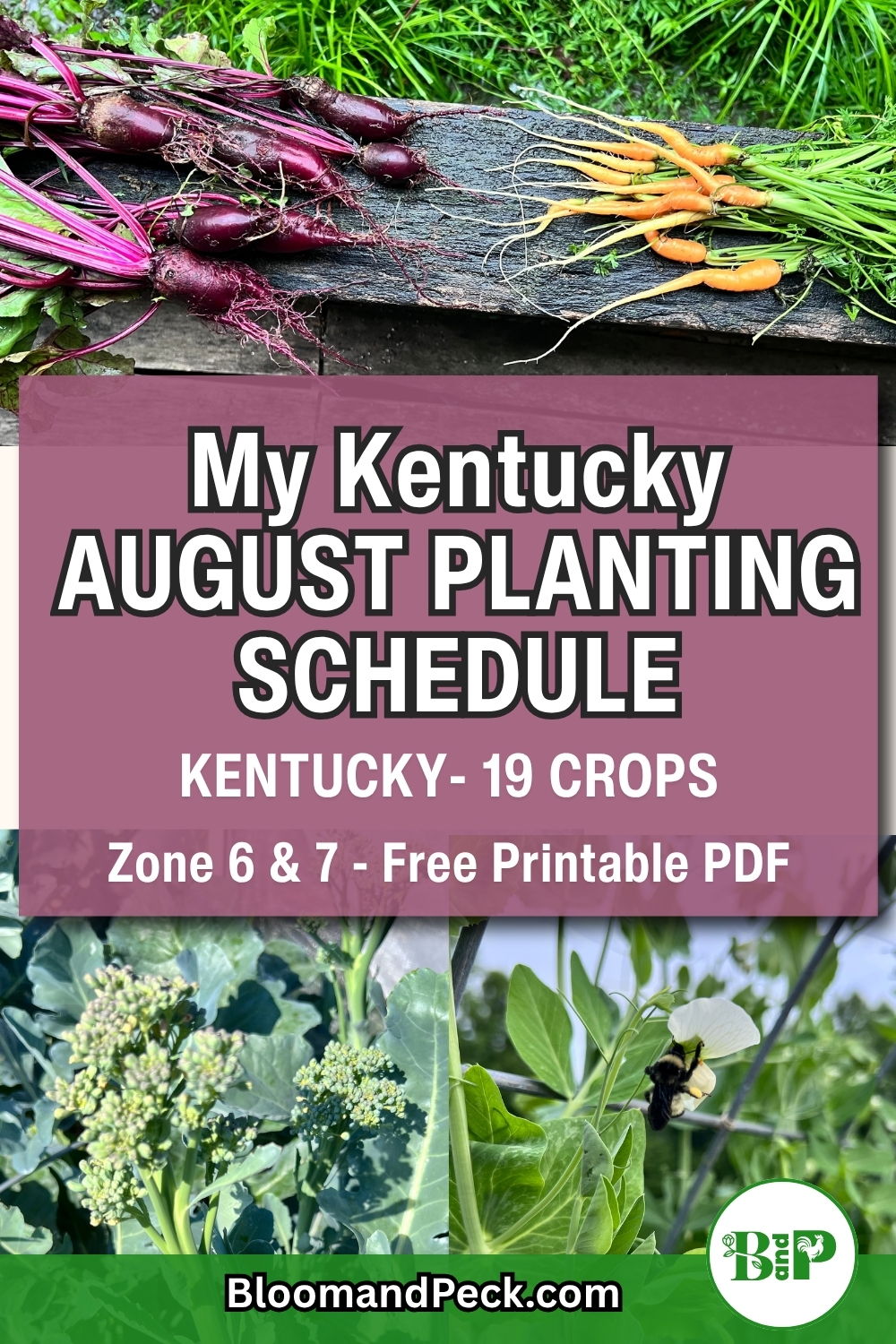
If you are like me, searching for what to plant in August in Kentucky you might be surprised to find out how much is actually going in the ground this month. So much to harvest and the crazy amount of pests still attacking.
August feels like the height of summer but it is quietly one of the most important planting months of the whole year in Kentucky. The fall garden starts now. If you wait until September it is already too late for most of it.
I am up here on the ridge in Columbia, Zone 7a, and August is the month the garden runs in two directions at once. One hand is harvesting everything the spring and summer plantings worked toward — pole beans, cantaloupe, Sugar Baby watermelon, peppers, Thelma Sanders squash. The other hand is getting the fall garden in the ground before the window closes.
For the complete month-by-month schedule, see our Kentucky Vegetable Planting Calendar.

🌱 We grow our own vegetables to control exactly what goes into our food—no pesticides we didn’t choose, no wondering where it came from. July is the month the garden shifts into two gears at once.
If you missed the earlier posts in this series you can find April [April post Here], May [link], and June [link], July {link} — everything growing in the garden right now traces back to those months. And the Kentucky Garden Calendar page is pretty awesome resource too. And there is still plenty to plant. Here’s exactly what to plant this month in zones 6b, 7a, and 7b across Western, Central, and Eastern Kentucky.
This post contains affiliate links to Epic Gardening and other trusted companies. If you purchase through these links, I may earn a small commission at no extra cost to you. I only recommend products I personally use in my Zone 7a Kentucky garden.
Quick Answer: What to Plant in August in Kentucky
👇 Use the interactive calendar below for exact dates by zone — then keep reading for what I’m actually doing on my Zone 7a homestead this month. (You can jump to the calendar using the table of contents below)
Transplant Outside: Broccoli, cabbage, rhubarb
Direct Seed Now: Carrots, beets, radishes, lettuce, spinach, mustard greens
High Tunnel: Begin fall succession planting — lettuce, spinach, carrots, beets
Harvest Now: Pole beans, cantaloupe, watermelon watching, peppers, cucumbers finishing up, Thelma Sanders, tomatoes
Watch For: Powdery mildew on squash, heat stress, consistent watering
A Quick Note on My July Kentucky Garden
July gardening in Kentucky is a crazy weather month. From stuffy humidity to 90 degrees plus, to rain storms, to huge wind blowing over your tomato plants, to fog, July has most of it. I was able to collect rain water when it came and was grateful for my home dehumidifiers to fill the gaps in water.
The homemade pickle cucumbers were a fantastic success, and the Kentucky beefsteak tomatoes were a huge surprise. The basil did amazing as usual and I learned to plant less tomatoes as the San Marzano paste tomatoes filled my freezer, cupboards and tummy!
What to Plant in August In Kentucky
August in Kentucky is fall garden jumpstart month. The crops you direct seed and transplant now are what you will be harvesting in October and November — and cool weather makes those harvests taste better than anything you grew in the heat of summer. Fall broccoli, fall carrots, fall beets — they are genuinely sweeter and more tender than their spring versions and most people have never experienced that.
The key in August is not waiting for it to feel like fall before you plant. You plant in the heat so the crops are ready when the cool arrives. It feels counterintuitive but that is exactly how Kentucky fall gardening works.
If you have a high tunnel of any size, this month becomes even more interesting — you are managing a full summer harvest inside while starting to make room and plan for the fall succession that will extend your season deep into November and beyond.
Still keeping an eye on powdery mildew and all the pests.
This is the start of The fall Garden at the same time you are harvesting everything. Burnout starts here, and it’s ok. Just do what you want to and what you can.
I found food banks can take extra produce and it really helps the community. Here is the link I found to donate to your county.
Looking for zone specific Printable Vegetable Calendar?
YES, all twelve months, In ONE printable calendar. Written by a Zone 7a homesteader growing food to feed the family & sharing as I learn.
Plus occasional real-talk homesteading tips. No woo-woo, just what works.
What if I Don’t What if I Don’t Have Starts Ready in August?
For broccoli and cabbage you should have started those indoors in July — if you did, they are ready to go outside now. If you missed that window check your local nurseries and farmers markets in early August — some will have fall transplants available

For direct seeding crops like carrots, beets, radishes, lettuce, and spinach — those go straight in the ground now, no indoor starting needed.

Direct seed crops like carrots, beets, and mustard — those go straight in the ground now. No indoor starting needed.
What I’m Actually Planting in August — On My Kentucky Homestead
Here’s what is happening on my ridge this month. Your timing may shift a little depending on whether you are in western, central, or eastern Kentucky — but the general flow is the same.
Transplanting Outside
The broccoli and cabbage starts I started indoors in July are going outside this month. I left rows for them in the outside garden specifically — knowing back in July that August was their moment. Fall broccoli in Kentucky is genuinely better than spring broccoli. Cooler temperatures as it matures bring out a sweetness that spring crops grown in warming weather just cannot match. If you have never grown fall broccoli you are missing the best version of it. [link to broccoli post]

I do love these (seen above) Epic gardening seed starting trays, heat mats and more, you can see them here if you need supplies.
And then there is the rhubarb. I have one plant. One. It’s been in a tiny pot for two years at my homestead before I purchased it, poor thing. But rhubarb is a long game — you plant it once and it comes back for decades. I have a planter ring, where it will get partial shade in the late day, I am going to put it in next to the fruit trees. Late August is the right time in Kentucky to get it established before winter sets in and I have been waiting all season for this moment. It is not a market garden move. It is a twenty year move. University of Kentucky ID128 says Divide old rhubarb or plant crowns if not done in spring, so fingers crossed this will work!
Direct Seeded Outdoors
August is one of the best direct seeding months of the whole year if you are thinking about fall. Here is what is going in the ground:
🥕 Carrots and beets are going in again — this is the succession planting that matters most for fall harvest. Fall carrots and beets are sweeter than spring ones and they store beautifully. [link to beets post] I am also testing carrots and beets in grow bags this month to see how they perform compared to the raised beds — I will report back on that. [link to grow bags]
I read that book Carrots Love Tomatoes, so I think I will try some carrots around my tomatoes in the high tunnel.
The UKY Cooperative Extension Service says that good carrots for the fall are:
Bolero
Mokum
Napoli
to name a few.
Special mention I am going to try: Shin Kuroda They are said to be heat tolerant and do well in heavy soil. Which might make them a great fit for Kentucky!

Radishes are going in this month but I want to stop here because this is something I genuinely did not know until recently:
There are spring radishes and fall radishes. Mind blown! The things you learn when you grow in a hot box state!
I grew White Icicle this spring and pickled them, which was wonderful. But White Icicle is a spring radish — fast, mild, small, and it bolts in summer heat.
What goes in the ground in August is a fall radish — Daikon, Black Spanish, Watermelon radish, China Rose. These are completely different — larger-they might get super big in fact, spicier, 50 to 70 days to maturity, and specifically bred to be planted in late summer for fall harvest.
If you planted spring radishes in August and they failed, this is exactly why. The variety matters as much as the timing.

🥬Lettuce, spinach, and mustard greens are all going in now for fall harvest. I am planting enough for two people plus enough to share with our adult kids and my grandson who has decided he loves lettuce on his cheese burger (grandpas are the best he says).
Grab some seeds Here and save 5% at no extra cost to you
🫛 Peas are one thing we all love to munch on this homestead. I have a love hate relationship with them and the powdery mildew issue I had. Now, I am looking forward to trying another variety for fall. I am searching for some varieties at Epic Gardening, and for fall I think I am going to try Green Arrow for my fall harvest! They are on the UKY recommend variety list for shelling peas.

🥬 Something I enjoy growing, eating and sharing with the chickens, Bok Choy (or Pac Choy)! It also became an accidental trap crop for Japanese beetles my first year growing cucumbers in Kentucky. These earn their place in my garden every year.

The plan is to direct seed outside first and then succession plant into the high tunnel as the outside crops finish up. The tunnel extends the season significantly — crops that would be done by October outside can keep going into November and beyond inside. That is our why for having a high tunnel / poly tunnel.
There are even more things you can plant you will see in the interactive calendar, these are a few things we enjoy eating.
What’s Happening Inside the High Tunnel
Even though our high tunnel is not complete, I am taking advantage of it. The University of Kentucky has high tunnel planting calendars for all three Kentucky regions that I reference for tunnel timing — they are genuinely useful if you are managing a tunnel and want zone specific guidance. [link to UK high tunnel calendars]
Inside the tunnel this month I am starting to make room for fall. The rows I left for broccoli and cabbage transplants are ready. Some tomato plants that have been showing yellowing on the tops of the leaves may be coming out — I am still investigating the cause. And honestly, I planted way too many lol I wanted ALL the Sauces! It isn’t something that is spreading, so I am watching and researching before I make any decisions. This is the part of homesteading nobody talks about — sometimes you are just not sure what is wrong and you have to sit with it for a bit.
Everything else in the tunnel is still producing — peppers, basil, rosemary, thyme, cucumbers are about done, Thelma Sanders, and the Sugar Baby watermelon which I am watching very closely right now.
OH I may be preparing a bed for garlic too! That comes in November.
What I’m Harvesting in August
August is when the garden really pays you back. Here is what is coming in this month:
Pole beans — (direct seeded June 4th) Kentucky Blue, Kentucky Wonder, and Malibu are all maturing in waves through August. Kentucky Blue produces August 6th, Kentucky Wonder around August 21st, and Malibu started producing August 2nd. The harvest should be continuous for five to six weeks from mid August onward. This is one of the most satisfying harvest of the season so far — watching those beans come off the cattle panel trellis in the raised bed is exactly what I planted them for.

Cantaloupe — the cantaloupe on the outside arch dropped a couple fruits on the ground August 7th lol. One day they were green, next day ready! This was one of my favorite experiments this season — watching it climb the cattle panel trellis and now waiting for that first ripe one. You know cantaloupe is ready when it slips easily from the vine with gentle pressure and the blossom end gives slightly. [link to cantaloupe post]
Pickling cucumbers — these went into the high tunnel June 1st and have been producing beautifully. They should be finishing up by end of August. I will be sad to see them go but they had a good run. [link to cucumber post]

Sugar Baby watermelon — this is the one I am watching most closely. Two formed on the vine — one shriveled up early and the other took off, which is completely normal. Nature self selects. The little melons are sizing up now and I am learning the signs of ripeness in real time right along with you. For Sugar Baby you are looking for a dried brown tendril nearest the fruit, a dull rather than shiny skin, and a hollow sound when you thump it. Days to maturity is 75-80 days from transplant — which puts my harvest window in mid to late August. I will report back.

Thelma Sanders squash — this heirloom acorn type squash has been one of my favorite surprises of the season. She is sizing up beautifully inside the tunnel and I cannot wait to tell you how she tastes. If you have never heard of Thelma Sanders she is worth looking up — creamy sweet flesh, pale yellow skin, and the kind of variety you find when you go down the heirloom rabbit hole and never come back. [link to Thelma Sanders]

Peppers — still producing and I am still picking. The pepperochini went into pickling in July. Bell peppers and jalapeños are coming on now — though the jalapeños had a mite issue earlier in the season that I am still watching. [link to pepper post]
Basil — I love basil. I am growing the Italian basil and it is still producing. I have to keep an eye on it because it is starting to flower in August. But I do pick it often and freeze it on sheets to have that sunshine flavor all year .[link to storing basil] Did I mention it is an awesome companion plant too?
☀️ August brings more bugs. See below.
August Garden Maintenance — What to Stay On Top Of
August in Kentucky is hot. Ninety plus degrees, muggy, and relentless. The kind of heat that makes you water at dawn and stay inside by noon. Three things I am focused on:
Watering — everything needs consistent deep watering especially inside the high tunnel where heat builds fast. I check daily. This is not optional in a Kentucky August.
Weeding — July taught me a hard lesson about turning your back on weeds for a week. The outside garden got away from me and I spent real time fighting it back. August I am staying on top of it earlier and more consistently. The raised beds are safe. The open ground requires vigilance.
Mulching — keeping two to three inches of mulch around everything retains moisture, keeps soil temperatures down, and reduces how often you need to water. In August heat this becomes critical.
Bug and disease checks — August pest pressure is real. I am watching for squash vine borers, aphids, cucumber beetles, and continuing to monitor the tomato yellowing situation.
University of Kentucky Entomology department has a vegetable pest activity calendar that I reference regularly — it tells you exactly which pests are most active by month so you know what to watch for.

Is It Too Late to Plant in August in Kentucky?
Not at all — August is one of the most important planting months for fall harvests in Kentucky. Direct seed carrots, beets, radishes, lettuce, spinach, and mustard greens now. Transplant broccoli and cabbage outside now. Get succession planting started in the high tunnel if you have one. The window for most fall crops is open right now and closes fast as September arrives.
August Planting Calendar for Kentucky Zone 6 and Zone 7
This is an approximation with information from the UK Cooperative Extension. Kentucky is full of microclimates. For example, my kitchen garden things are colder than my ridgetop garden, and the holler is cooler yet. Check with your local extension office or look up your frost dates by zip code. (see note after this calendar if you need more assistance)
Check with your local extension office or look up your frost dates by zip code. Learn more about the two zone system at play in Kentucky https://bloomandpeck.com/kentucky-vegetable-planting-calendar/

🌻While you're checking your zone above, I'm just hoping the deer leave my beans alone long enough to get some to pickle.
🌱 Want Every Month's Planting Dates in One Place?
You just got August. Get the whole year — zone-specific planting dates for 30+ vegetables, all twelve months, one printable calendar. Written by a Zone 7a homesteader growing to feed her own family, not to sell you something.
Plus occasional real-talk homesteading tips. No woo-woo, just what works.
What will you be planting in in August in Kentucky? Share in the comments!
Sources & Resources
Planting dates and crop information referenced from the University of Kentucky Cooperative Extension — Home Vegetable Gardening in Kentucky (ID-128) and the UK Ag Weather Center June Planting Calendar. Pest activity calendar from UK Entomology Vegetable Pest Activity.
Leave a Reply